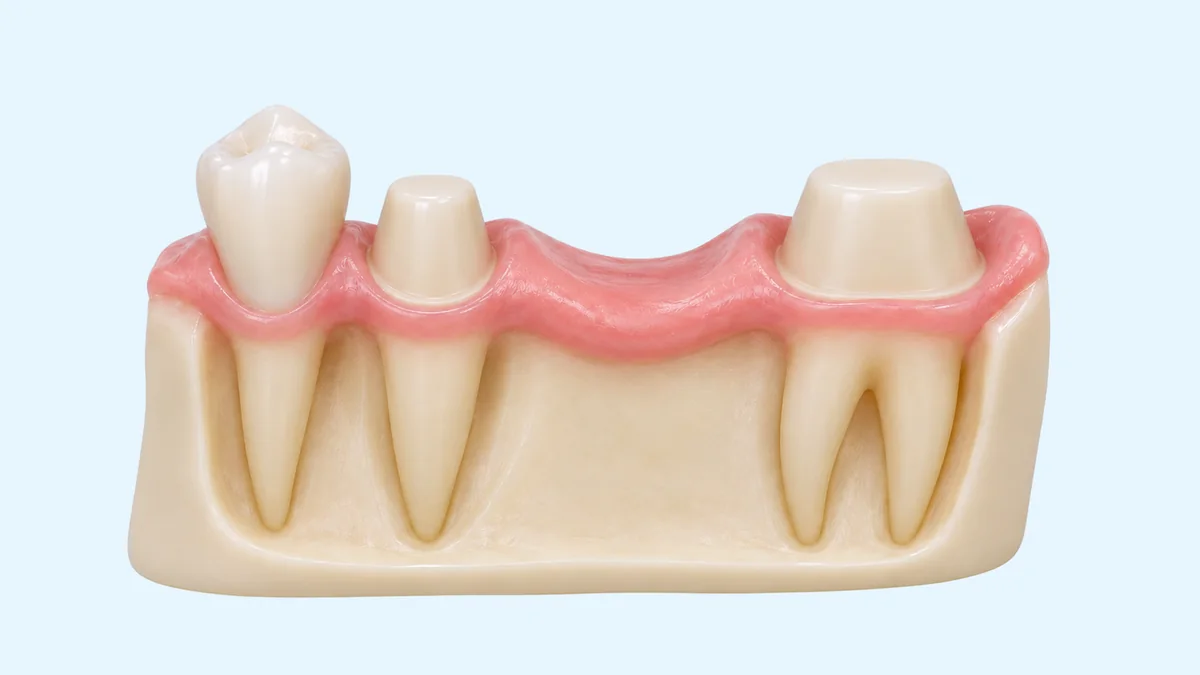
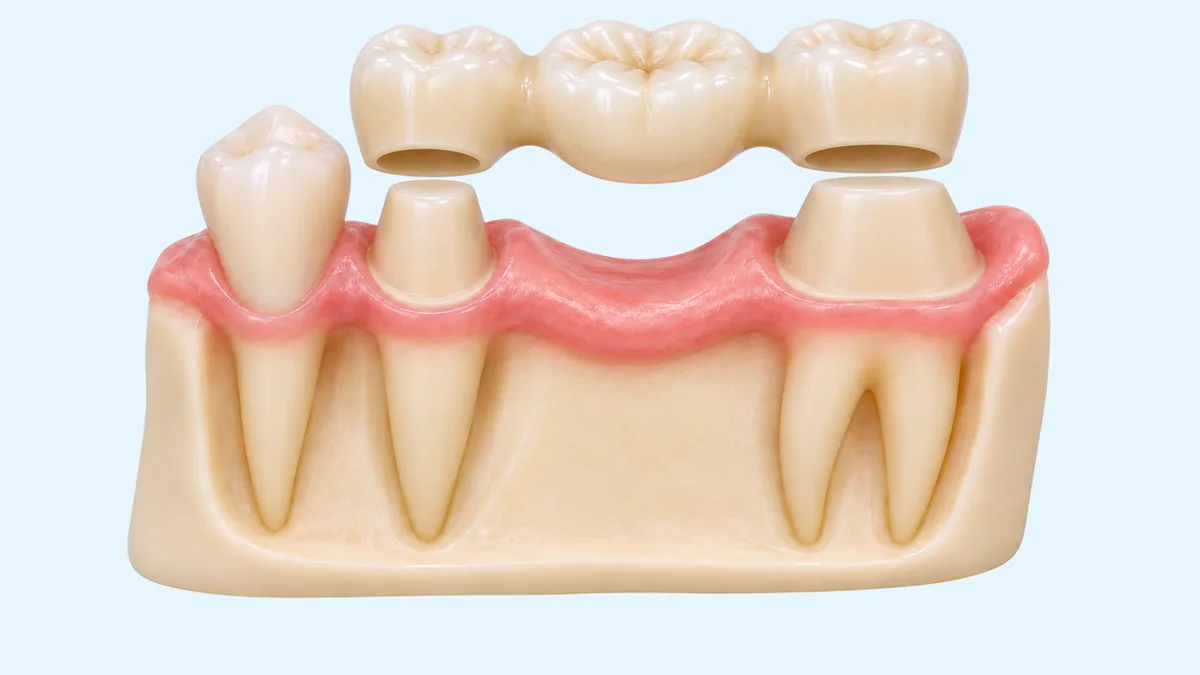
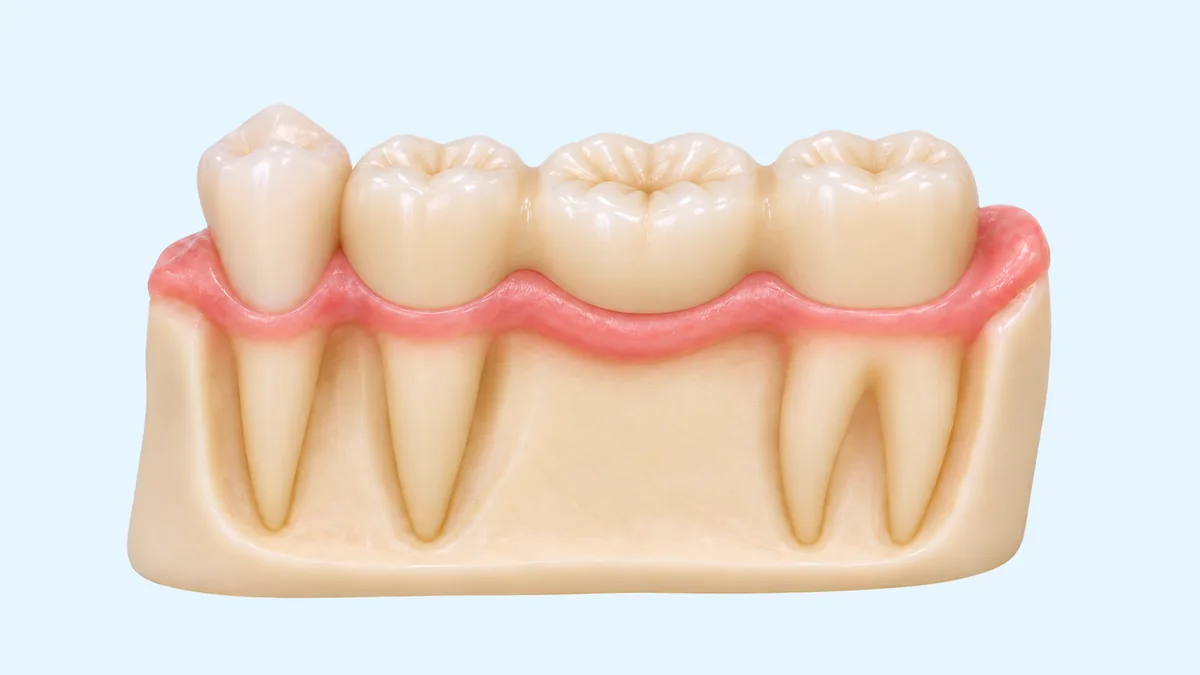
Traditional dental bridge
Who it suits: A gap with strong teeth on both sides, especially if they need crowns anyway.
What it does: Crowns on both neighbours carry a false tooth. It is fixed and needs no surgery.

Treatments · Vogue Clinics
A fixed replacement for a missing tooth, held by crowns on the teeth either side of the gap.

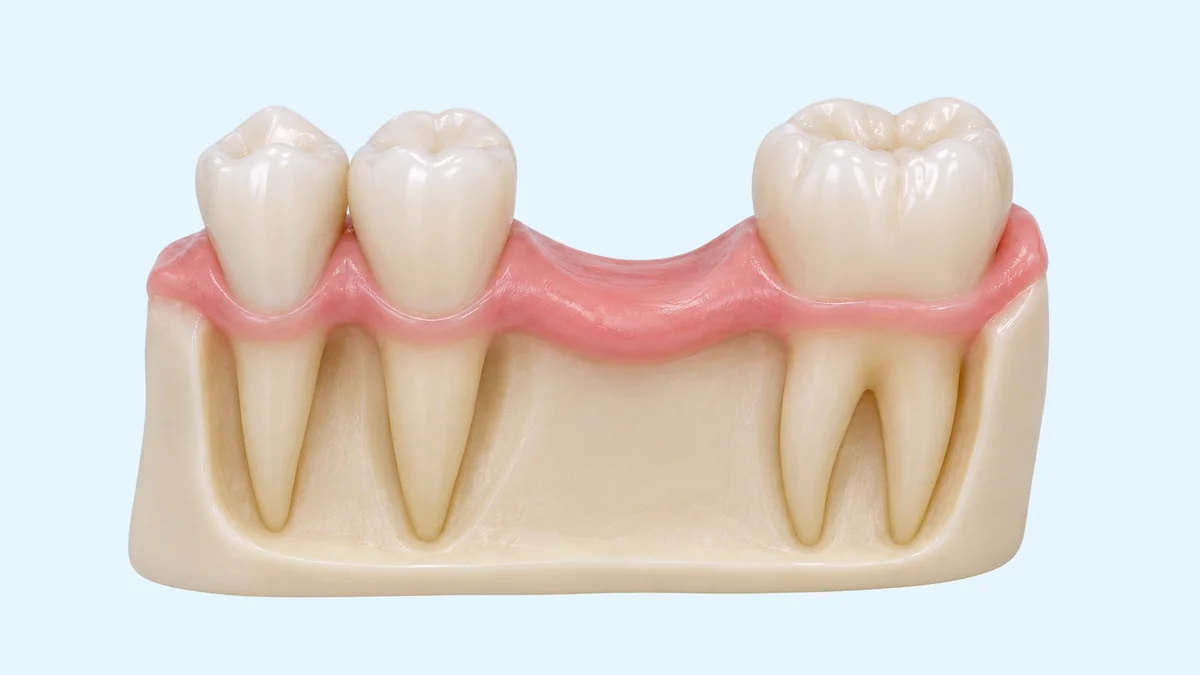
Illustration for explanation only. Whether a bridge or an implant suits your gap is decided from your own examination and X-rays.
What is a dental bridge and who is it for?
A dental bridge replaces a missing tooth with a false tooth fixed between crowns on the teeth either side of the gap. It is cemented and doesn't come out. It suits gaps with strong neighbours, especially if they already need crowns; when they are healthy and untouched, an implant is often the better choice.
Which option suits you is decided at your examination, not on this page.
Send a photo, and an X-ray if you have one, on WhatsApp or through the form. Tell us where the gap is and whether the teeth beside it have fillings or crowns.
A bridge does its job for as long as the teeth under it stay healthy. Clean under the false tooth every day, keep up check-ups with X-rays, and tell us early if a supporting tooth aches or the bridge feels loose. Routine check-ups can be done by a dentist near your home, and your coordinator stays reachable.
This is the question we hear most about bridges. The honest answer depends on the teeth next to the gap.
If they are healthy and unfilled, a bridge means filing them down to hold a false tooth, and that can't be undone. An implant replaces the missing tooth by itself and leaves the neighbours alone.
| Bridge | Implant | |
|---|---|---|
| Neighbouring teeth | Reduced for crowns | Left untouched |
| Surgery | None | Needed to place the implant |
| Waiting | No healing period between steps | Usually three to six months of healing before the final tooth |
| Bone under the gap | Slowly shrinks over the years | The implant usually helps keep it |
| Cleaning | Special floss or small brushes under the false tooth | Much like a natural tooth |
In these situations a bridge is not a second-best option, and our dentists may suggest it ahead of an implant.
The supporting teeth are shaped under local anaesthesia, scanned and covered with a temporary bridge. The finished bridge is tried in, adjusted to your bite and then cemented. Bridges are usually made from zirconia; metal-supported porcelain is an option for some longer spans.
How many visits you need depends on your case; your written plan states it.
Cleaning decides much of how long a bridge serves you. Food and plaque collect under the false tooth, so you'll need floss threaders, special floss or small interdental brushes, and we show you how at the fitting. Decay or gum disease around a supporting tooth is one of the most common reasons a bridge has to be redone.
There is no fixed number of years. A bridge usually comes to the end of its life because something happens to a supporting tooth, not because the bridge itself wears out.
These are the things that make the difference:
Often, yes, if the supporting teeth are healthy and the bridge is undamaged. A loose bridge may point to a failed seal or to decay under a crown; an examination and an X-ray show which.
Until you are seen:
Your treatment journey
From your first message to the follow-up after you fly home, one coordinator stays with you.
From home
A few smile photos or a recent X-ray on WhatsApp is enough to start.
From home
Our dentists prepare your treatment plan and quote, in writing.
Istanbul
We organise appointments, hotel and transfers around your treatment.
At the clinic
Digital impressions and smile design let you see the plan before anything begins. A coordinator translates in the chair and explains each step.
Back home
Your coordinator stays reachable after you've flown home.
Every dentist at our clinics provides this treatment.

Head Dentist · Founder · Ataşehir and Bağdat Caddesi

Dentist · Branch director, Bağdat Caddesi

Dentist

Dentist · Aesthetic and prosthetic dentistry

Orthodontist

Endodontist

Dentist · Pediatric dentistry

Dentist

Dentist · Bağdat Caddesi

Dentist · PhD programme in Restorative Dentistry

Dentist

Dentist

Pediatric Dentist
Dentist
You can have this treatment at both of our Istanbul clinics: Dental clinic in Ataşehir, Istanbul and Dental clinic in Kadıköy, Bağdat Caddesi.
It depends on the gaps. A bridge is fixed and suits a single, short gap with sound teeth on both sides, but those teeth are filed down for crowns. A partial denture is removable and can fill several gaps at once, with your own teeth reshaped little or not at all, though it feels bulkier and clasps may show. Your dentist compares both at your examination.
A bridge isn't finished in one visit. The supporting teeth are shaped and scanned, a temporary bridge fills the gap while the bridge is made, and then it is tried in and cemented. Unless an extraction or other treatment comes first, there is no healing period between steps. How many appointments you need depends on your case, and your written plan states it.
The supporting teeth are numbed with local anaesthetic before they are shaped, so most people feel pressure rather than pain. Afterwards the teeth may be sensitive to cold and the gum under the false tooth tender; this usually eases. Pain that grows, or pain when you chew, can mean a high spot on the bite or a problem in a supporting tooth, so contact us.
A bridge is an established, fixed way to replace a missing tooth, with no surgery. The main drawbacks are that the supporting teeth are filed down for good, the area under the false tooth needs daily cleaning with floss threaders or small brushes, and the bone under the gap slowly shrinks over the years. A problem in one supporting tooth can also affect the whole bridge.
The bridge itself doesn't smell; bad breath usually comes from food and plaque trapped under the false tooth. Ordinary floss can't reach there, so you need a floss threader, special floss or small interdental brushes, and we show you how to use them when the bridge is fitted. If the smell persists despite cleaning, decay or gum disease around a supporting tooth should be checked.
Bridges are usually made of zirconia, a strong, metal-free, tooth-coloured ceramic that handles the load across a gap well. For some longer bridges, porcelain fused to metal is also an option; it is strong, but the metal can show as a grey edge if the gum recedes. E.max is used mostly for single crowns rather than bridges. Your dentist chooses from the length of the gap and your bite.
No. A bridge doesn't cause bone loss, but it doesn't prevent it either: the false tooth rests on the gum, and once a tooth is lost the bone under the gap slowly shrinks over the years. An implant usually helps keep that bone. This is one of the points your dentist weighs with you when comparing a bridge with an implant.
The gum and bone change shape as they heal after an extraction, so the final bridge is usually made once healing has progressed enough for the false tooth to sit well against the gum. A temporary bridge can fill the gap in the meantime. How long to wait depends on the extraction and on how you heal; your dentist states it in your plan.
Not usually. Root canal treatment is needed only if the nerve of a supporting tooth is infected or badly damaged, which X-rays and simple tests show. A tooth that has already had root canal treatment can support a bridge, but because it is often weaker, it needs closer monitoring. Your dentist checks the roots, bone and gums of each supporting tooth first.
A bridge is fixed: it is cemented onto the supporting teeth and you can't take it out. Only a dentist can remove it, for example to treat a supporting tooth or to replace the bridge. How long it stays depends mostly on the health of those supporting teeth. If you want something you can take out yourself, a partial denture is the removable option.
Unless an extraction or other treatment comes first, a bridge has no healing period between steps. How many days to allow depends on your case; your written plan states it.
This page is for general information and doesn't replace an examination by a dentist.
Start here
A dentist looks at it and we reply with honest options and a written plan. You don't have to commit to anything.
Mon–Sat 09:30–18:30
Get directions