Implant-retained overdenture
Who it suits: People with a loose denture who want it to stay put, without a fixed bridge.
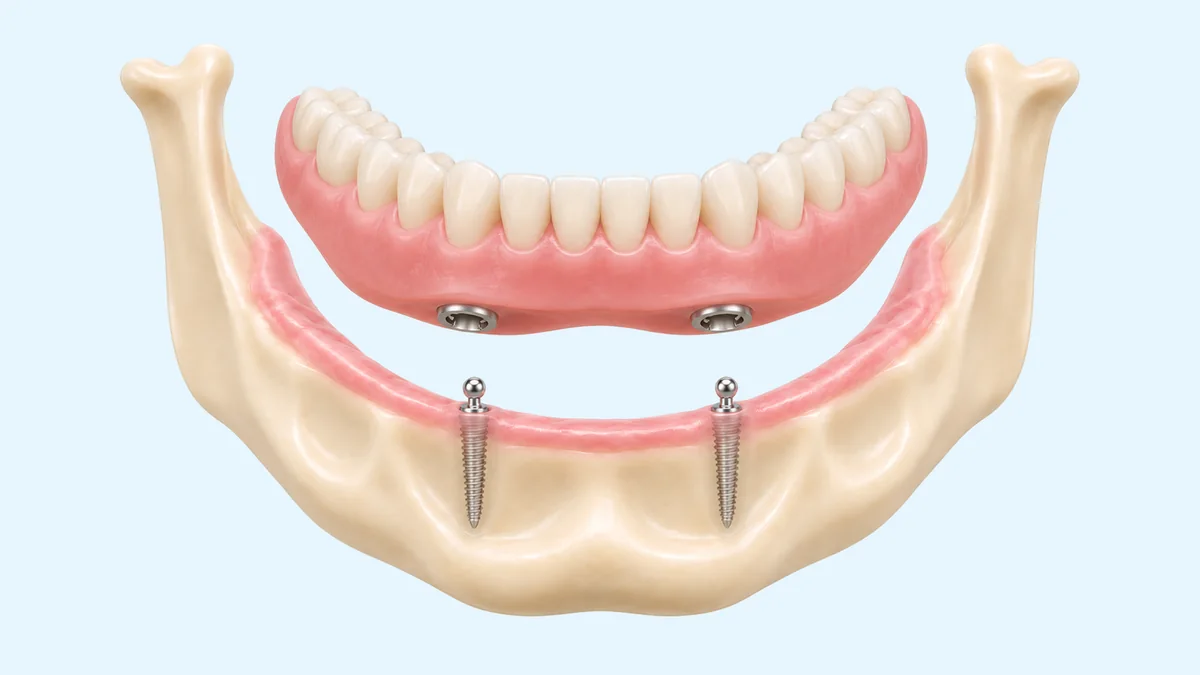
What it does: The denture clips onto a small number of implants and comes out every day for cleaning.

Treatments · Vogue Clinics
A denture that clips onto implants, so it stays in place but still comes out for cleaning.

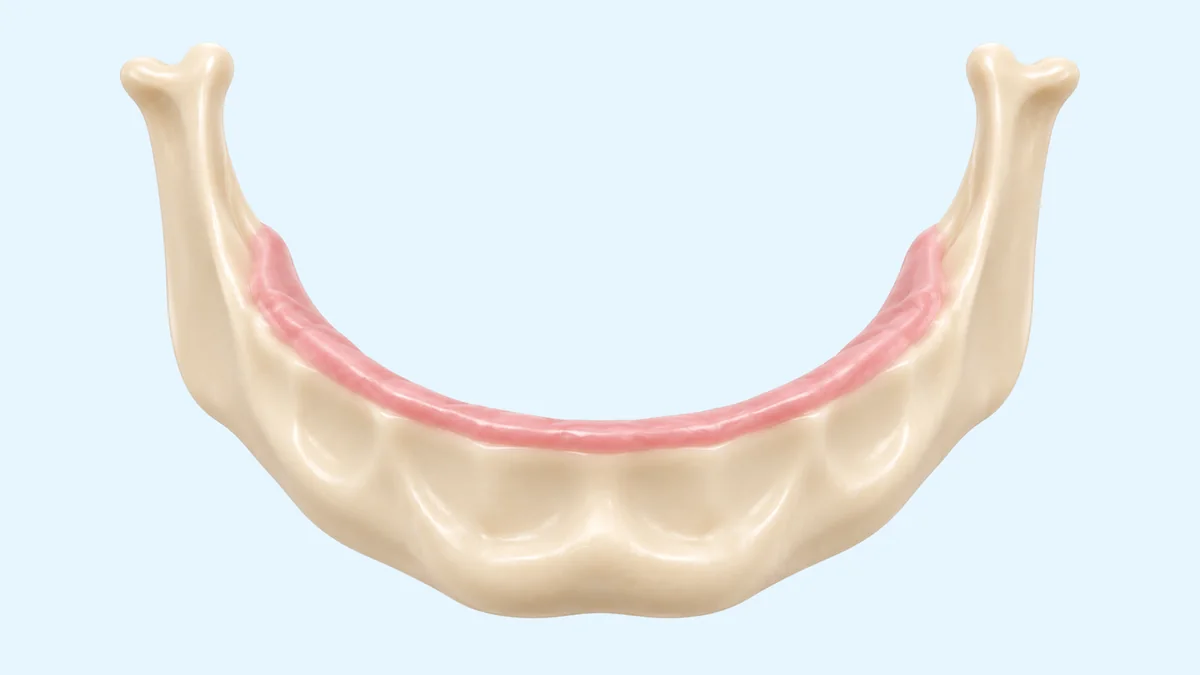
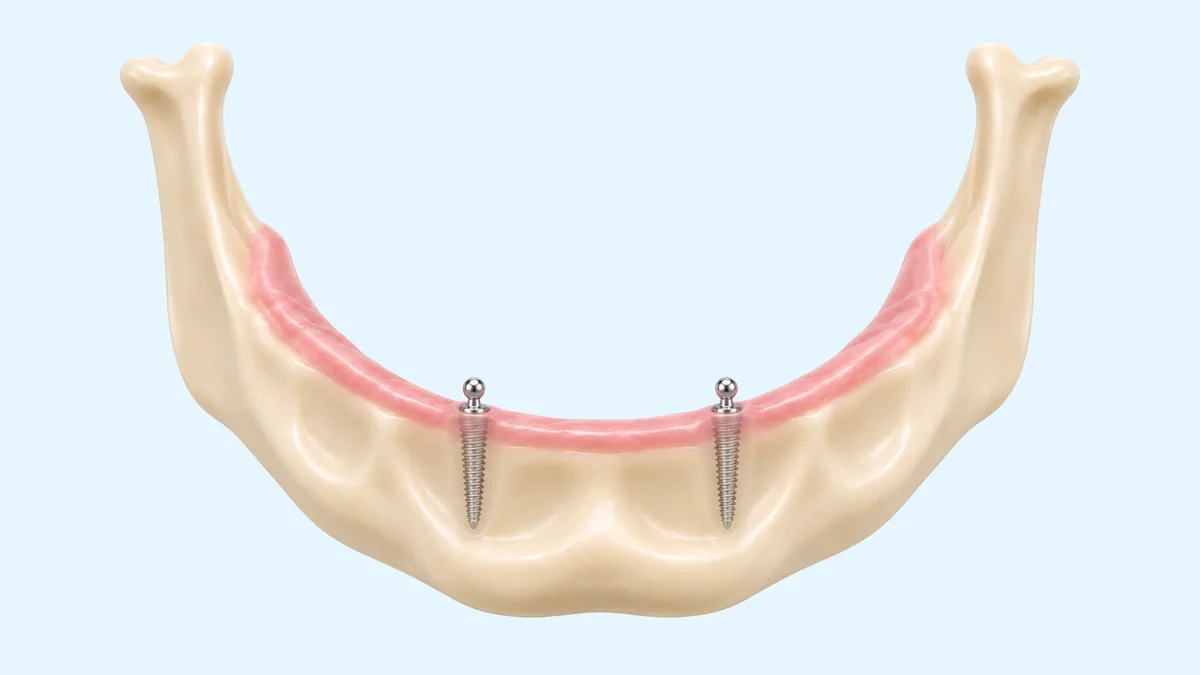
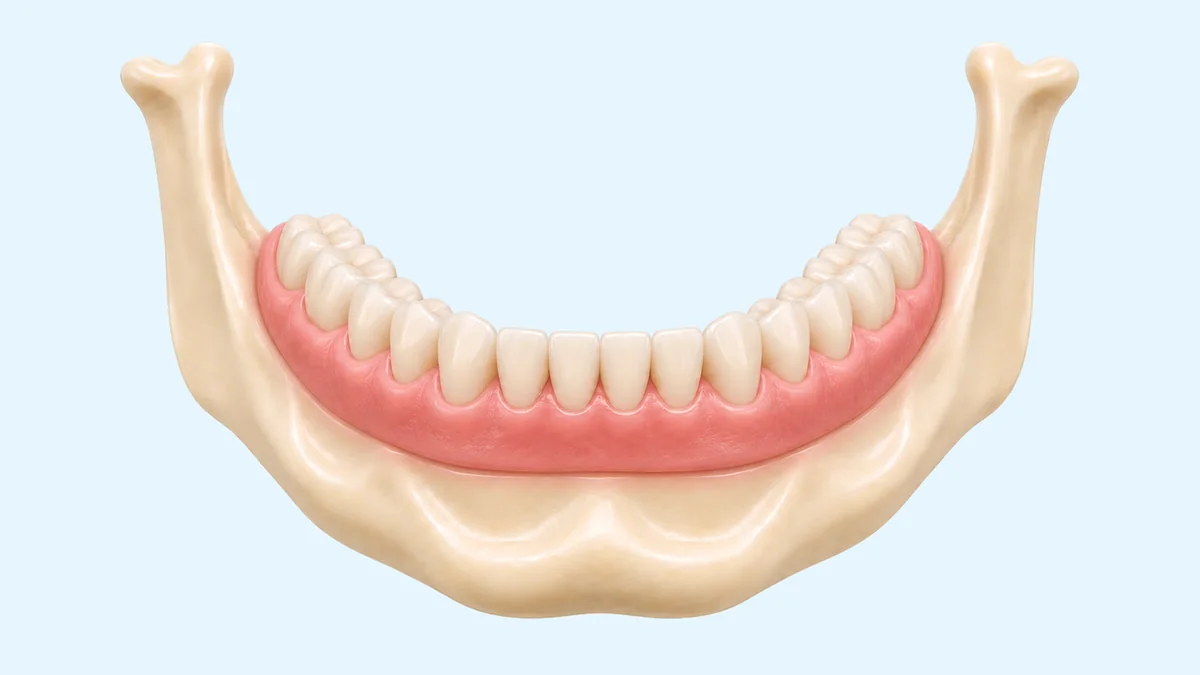
Illustration for explanation only. It shows two implants in the lower jaw as an example. Your dentist decides from your own scan how many implants you need and which type of attachment suits you.
What is an implant-supported denture and who is it for?
An implant-supported denture is a full denture that clips onto implants in the jaw, so it doesn't slip when you eat or speak. You take it out yourself to clean it. It suits people with no teeth in a jaw, especially those with a loose lower denture, who want more stability without a fixed bridge.
Which option suits you is decided at your examination, not on this page.
Send a photo of your denture and, if you have one, a panoramic X-ray on WhatsApp or through the form. Tell us which denture moves and when it bothers you most. A dentist looks at it before we reply.
Clean the denture and the attachments every day, and brush around the implants. The clips wear with use and are renewed when the denture feels looser. Routine check-ups can be done by a dentist near your home, and your coordinator stays reachable.
Both rest on implants. The difference is who takes the teeth out: you remove an implant-supported denture every day, while an All-on-4 or All-on-6 bridge can only be removed by your dentist.
| Implant-supported denture | All-on-4 / All-on-6 bridge | |
|---|---|---|
| Removal | You take it out to clean | Fixed; your dentist removes it for maintenance |
| Implants | Often fewer | Enough to carry a fixed bridge |
| Feel | Covers more of the gum, like a denture | Closer to fixed teeth |
| Cleaning | Out of the mouth, plus around the implants | Under the bridge, with special brushes |
| Upper jaw | The palate can sometimes be left open | The palate stays open |
A complaint we often hear is a lower denture that lifts when you talk or eat. Implants give it something to hold on to.
The implants are placed and given time to bond with the bone, typically three to six months. You can usually keep wearing an adjusted denture in the meantime. Then attachments are fitted to the implants, and the denture is made or adapted to clip onto them.
How many visits it takes depends on your case; your written plan states it.
Most problems are small and easy to fix if you come in early. These are the ones we see most often.
There is no single number for everyone. The lower jaw usually needs fewer implants than the upper, because the upper jaw bone is softer and a denture there may be made to leave the palate open.
Your bone, your bite and whether you might want a fixed bridge later all play a part. Your dentist explains the number on your scan.
Your treatment journey
From your first message to the follow-up after you fly home, one coordinator stays with you.
From home
A few smile photos or a recent X-ray on WhatsApp is enough to start.
From home
Our dentists prepare your treatment plan and quote, in writing.
Istanbul
We organise appointments, hotel and transfers around your treatment.
At the clinic
Digital impressions and smile design let you see the plan before anything begins. A coordinator translates in the chair and explains each step.
Back home
Your coordinator stays reachable after you've flown home.
Every dentist at our clinics provides this treatment.

Head Dentist · Founder · Ataşehir and Bağdat Caddesi

Dentist · Branch director, Bağdat Caddesi

Dentist

Dentist · Aesthetic and prosthetic dentistry

Orthodontist

Endodontist

Dentist · Pediatric dentistry

Dentist

Dentist · Bağdat Caddesi

Dentist · PhD programme in Restorative Dentistry

Dentist

Dentist

Pediatric Dentist
Dentist
You can have this treatment at both of our Istanbul clinics: Dental clinic in Ataşehir, Istanbul and Dental clinic in Kadıköy, Bağdat Caddesi.
Yes. An implant-supported denture clips onto implants, and you take it out yourself every day to clean it; your dentist shows you how to unclip it when it is fitted. If you want teeth that never come out, the alternative is a fixed bridge screwed onto implants, such as All-on-4, which only your dentist can remove for maintenance.
There is no fixed number of years, because the parts age differently. With good cleaning and check-ups, the implants can stay in place for many years. The small attachments wear with use and are replaced when the denture starts to feel loose. The gum under the denture also changes over time, so the fit is checked and adjusted, and the denture itself may eventually need renewing.
The two terms are often used for the same thing: a removable denture that clips onto implants. Where a distinction is made, an implant-retained denture is held in place by the implants but still rests partly on the gum, while in an implant-supported denture more of the biting force is carried by the implants, for example on a bar. Your dentist explains which design is planned for you.
A regular denture sits on the gum and is held by the shape of the jaw and suction, which a lower denture in particular often struggles with. An implant-supported denture clips onto implants, so it doesn't slip when you eat or speak. Both come out for cleaning. The difference is surgery: the implants have to be placed and heal first.
Because the denture doesn't lift when you bite, eating is usually easier than with a conventional denture. Depending on the type of attachment, it may move slightly under heavy chewing, so very hard food is best taken carefully. While the implants are healing, keep to softer food as your dentist advises. If food keeps getting under the denture, the fit may need checking.
They may help, but they don't stop it everywhere. After teeth are lost, the jaw bone gradually shrinks. Implants sit in the bone and pass chewing forces into it, which is generally thought to help preserve the bone around them, while the gum and bone under other parts of the denture keep changing over time. That is why the fit is checked and adjusted at check-ups.
Soreness and swelling after the implants are placed usually settle over the first days. The implants then need to bond with the bone, typically over three to six months, and during that time you usually keep wearing your adjusted old denture. Once healing is complete, the attachments are fitted and the denture is made or adapted to clip onto them.
The name is used for two different things. A snap-on denture that clips onto implants in the jaw is an implant-supported denture, and it stays in place much better than a conventional denture. Snap-on veneers, on the other hand, are cosmetic covers that clip over your own teeth for appearance only; they don't replace missing teeth and aren't made for chewing.
Usually one stage to place the implants and another, after healing, to fit the denture. Your written plan and quote set out both stages.
This page is for general information and doesn't replace an examination by a dentist.
Start here
A dentist looks at it and we reply with honest options and a written plan. You don't have to commit to anything.
Mon–Sat 09:30–18:30
Get directions