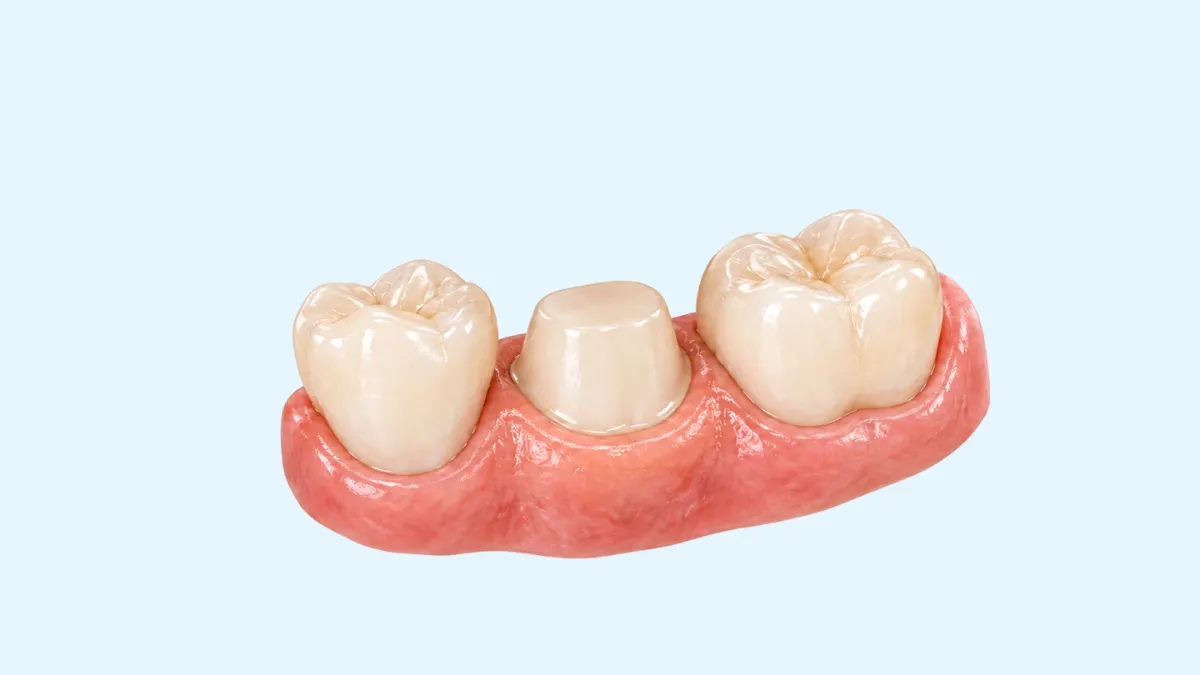
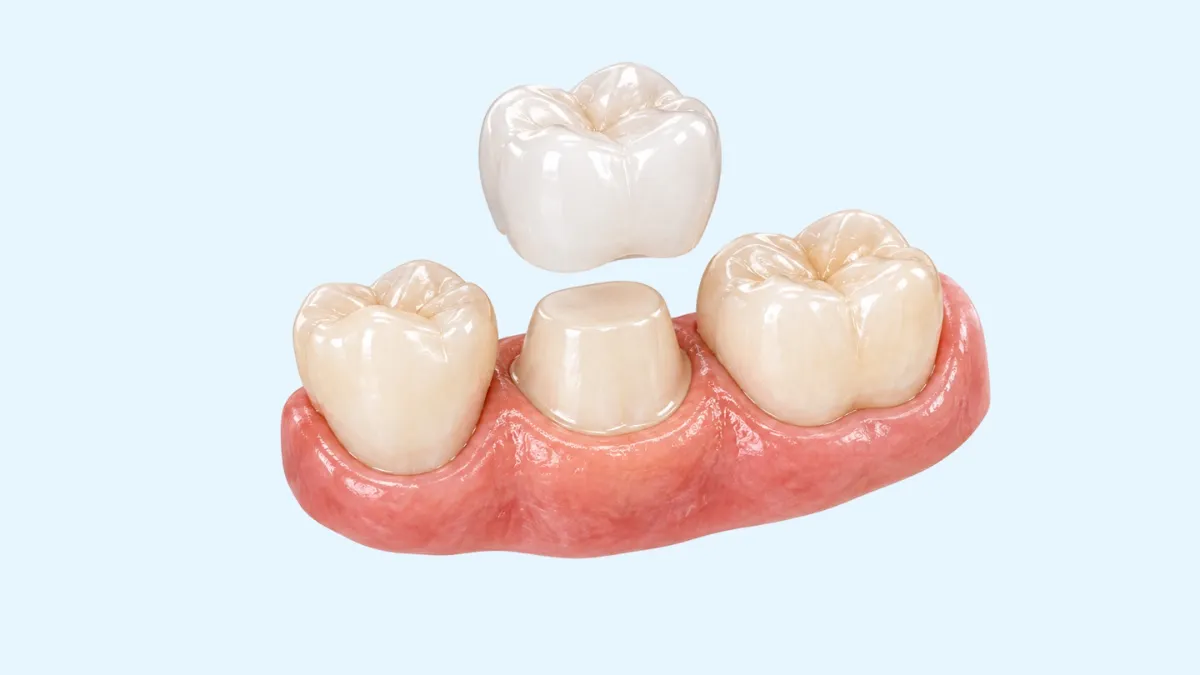
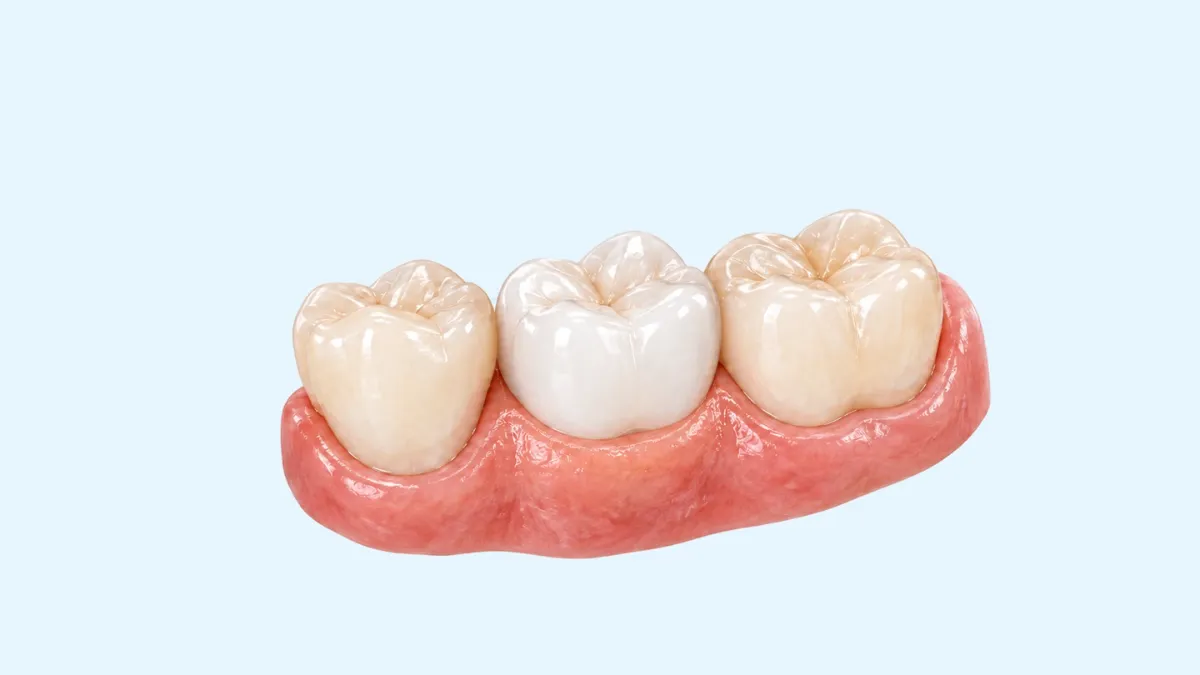
Zirconium crown
Who it suits: Back teeth, root-treated or heavily filled teeth, and people who grind or clench.
What it does: A metal-free cap that covers the whole tooth and stands up well to strong chewing forces.

Treatments · Vogue Clinics
Strong, natural-looking crowns for worn, broken or heavily filled teeth.

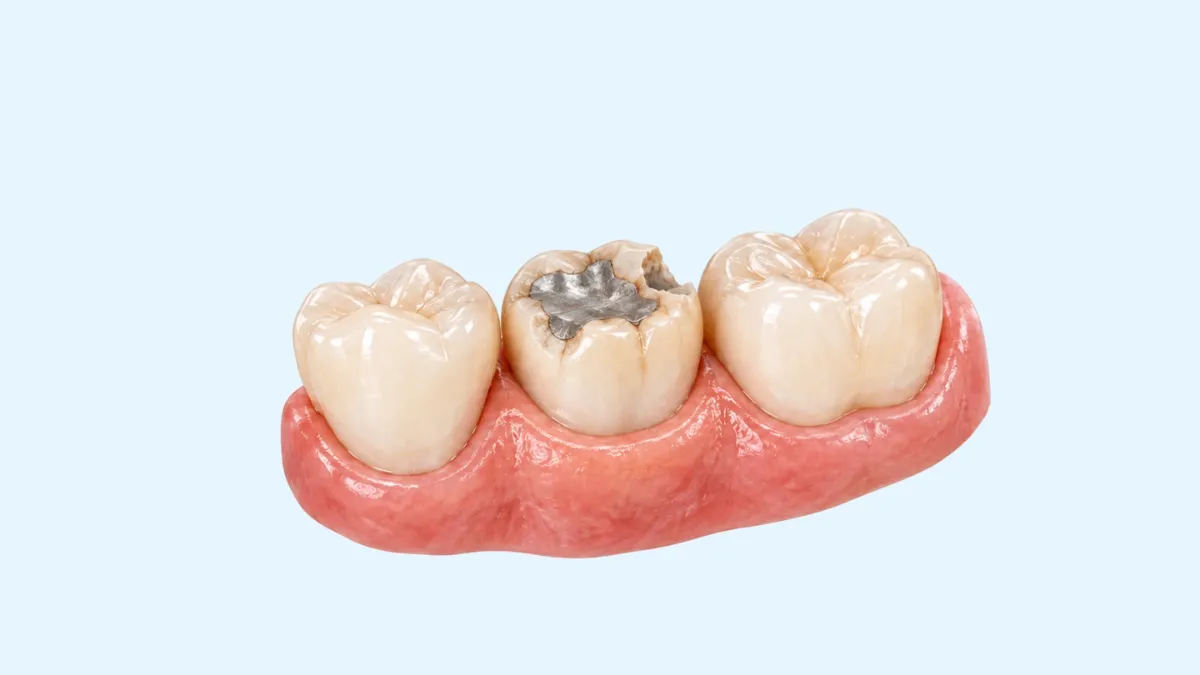
Illustration for explanation only. Which teeth need a crown, and which material suits each one, is decided at your examination.
Zirconium or E.max: which crown should I choose?
Zirconium is usually chosen for strength, so it suits back teeth, bridges and people who grind. E.max lets more light through, which often looks more natural on front teeth. Many full-mouth plans use both. Your dentist will recommend one per tooth based on your bite and how much tooth remains.
Which option suits you is decided at your examination, not on this page.
Send clear photos of your smile from the front and both sides on WhatsApp or through the form, with an X-ray if you have one. Tell us which teeth bother you and whether any already have crowns. A dentist looks at them before we reply.
The crowns are tried in your mouth. Your dentist checks the fit at the gum, the contact with the neighbouring teeth and your bite, and you look at shade and shape in the mirror and in daylight.
If something isn't right, say so now. Changes are made before anything is cemented.
Brush twice a day, clean between your teeth every day and keep coming for check-ups; X-rays at check-ups show what is happening under the edges. Routine check-ups can be done by a dentist near your home, and your coordinator stays reachable after you've flown home.
Not always. A crown removes more tooth than a filling or an onlay, so if a smaller restoration will hold, that's what we'll suggest.
Our dentists follow digital onlay cases over the long term for this reason: they keep more of your own tooth.
Shaping a tooth for a crown is done under local anaesthesia, so most patients feel pressure and hear the instruments rather than feel pain. The question we hear more often is about afterwards.
For some days the teeth may be sensitive to cold, and the gum at the edges may feel tender. If a tooth aches more as time passes instead of less, or hurts when you bite, contact us; the bite may need adjusting, or the nerve may need checking.
New crowns usually feel strange to your tongue for a short while. Most of the points below settle by themselves; a few need a quick visit.
A crown is a routine treatment, but shaping a tooth can't be undone. Your dentist goes through this list with you before any tooth is prepared.
Your treatment journey
From your first message to the follow-up after you fly home, one coordinator stays with you.
From home
A few smile photos or a recent X-ray on WhatsApp is enough to start.
From home
Our dentists prepare your treatment plan and quote, in writing.
Istanbul
We organise appointments, hotel and transfers around your treatment.
At the clinic
Digital impressions and smile design let you see the plan before anything begins. A coordinator translates in the chair and explains each step.
Back home
Your coordinator stays reachable after you've flown home.
Results vary from person to person. Your treatment is decided after a clinical examination.
Zirconia crowns
Zirconia crowns
I have had the best service. I have a few crowns and implant placed. This meant me coming to Istanbul twice. The service is exceptional, the co ordinator was efficient, the clinic is clean, the staff was polite and friendly and the quality of the crowns and implants used was exceptional. I came during the offer period and they kindly extended this finish my treatment at a later stage. I highly recommend the clinic and would come back in future if there is a need for further dental treatment.
Great experience!
Great experience from the moment I arrived in Istanbul, the clinic was great, professional and always here to help at every stage. I am happy with my crowns and my implants.
Great service
Thankyou to Deniz for getting all 3 of us in at late notice for 3 separate treatments thanks to Asude for looking after us and making sure everything's going ok thankyou to my dentist Atakan Always great service from having a filling, to crowns or implants we are always well looked after 5 star service keep up the good work
Every dentist at our clinics provides this treatment.

Head Dentist · Founder · Ataşehir and Bağdat Caddesi

Dentist · Branch director, Bağdat Caddesi

Dentist

Dentist · Aesthetic and prosthetic dentistry

Orthodontist

Endodontist

Dentist · Pediatric dentistry

Dentist

Dentist · Bağdat Caddesi

Dentist · PhD programme in Restorative Dentistry

Dentist

Dentist

Pediatric Dentist
Dentist
You can have this treatment at both of our Istanbul clinics: Dental clinic in Ataşehir, Istanbul and Dental clinic in Kadıköy, Bağdat Caddesi.
There is no fixed number of years; it varies from person to person. The zirconia itself rarely fails. What usually ends a crown's life is decay or gum problems at the edge, or heavy grinding. Daily brushing and flossing, regular check-ups and a night guard if you grind make the biggest difference, and a crown that does develop a problem can be replaced after an examination.
Zirconia is a metal-free, tooth-coloured ceramic that has been widely used in dentistry for many years. The side effects people notice usually come from the treatment rather than the material: some sensitivity after the tooth is shaped, and decay or gum problems at an edge that isn't kept clean. If you have a known allergy, tell your dentist before planning.
Often, yes. A small chip can sometimes be smoothed or repaired with composite, and a crown that comes off in one piece can often be cleaned and fixed back if the tooth underneath is healthy. Crowns usually come off because the cement fails or decay starts underneath. Keep the crown, don't glue it back yourself and bring it to us; a large fracture usually means a new crown.
The ceramic itself resists staining well, so a zirconia crown is not expected to change colour. If a crown seems darker or yellower, the cause is usually at the edge: stain or plaque building up, decay starting, or the gum receding to show the tooth or an old metal base. Your natural teeth can still pick up colour from coffee, tea or smoking, which can make a crown look different beside them.
A crown isn't finished in a single visit, because it is made in the laboratory between the appointment where your tooth is shaped and the one where the crown is fitted; a temporary crown protects the tooth in between. Unlike implants, crowns don't need a healing period between visits. How many appointments you need depends on how many teeth are treated and what comes first, and your written plan states it.
It depends on what 'porcelain' means in your plan, because the word is used both for metal-free ceramics and for porcelain fused to metal. Zirconia is the strongest tooth-coloured ceramic and is usually chosen for back teeth, bridges and people who grind. Porcelain over a metal base is strong too, but the metal can show as a grey edge if the gum recedes. Ask whether the crown contains metal.
Not always. Root canal treatment cleans and seals the inside of the tooth, while a crown covers and protects the outside, so the two do different jobs. Back teeth that have had root canal treatment are often weakened and are commonly protected with a crown or an onlay. Your dentist decides from how much tooth is left, once the root canal treatment is complete and the tooth is comfortable.
Yes. The crown itself can't decay, but the tooth underneath can, usually at the edge where crown meets tooth. That is why brushing, flossing and check-ups matter just as much after the crown is fitted. X-rays taken at check-ups show what is happening at the edges under the crown while any decay is still treatable.
Yes, but only by a dentist. A crown is cemented or bonded in place and is meant to stay. Zirconia is very hard, so removing a crown usually means cutting it off, and a new crown is then made. Replacing a crown is a common job when there is decay at the edge, a fracture, or a change you want in its colour or shape.
Usually, yes, but the gums are treated first. Inflamed gums bleed and can recede, which affects both how the crown fits and how its edge looks. At your examination your dentist checks the gum around each tooth; once it is healthy, the crowns are made, and daily cleaning and check-ups keep the gum around their edges healthy.
Unlike implants, crowns don't need a healing period between visits. How many days you stay depends on how many teeth are treated and whether fillings or root canal treatment come first; your written plan states it.
This page is for general information and doesn't replace an examination by a dentist.
Start here
A dentist looks at it and we reply with honest options and a written plan. You don't have to commit to anything.
Mon–Sat 09:30–18:30
Get directions