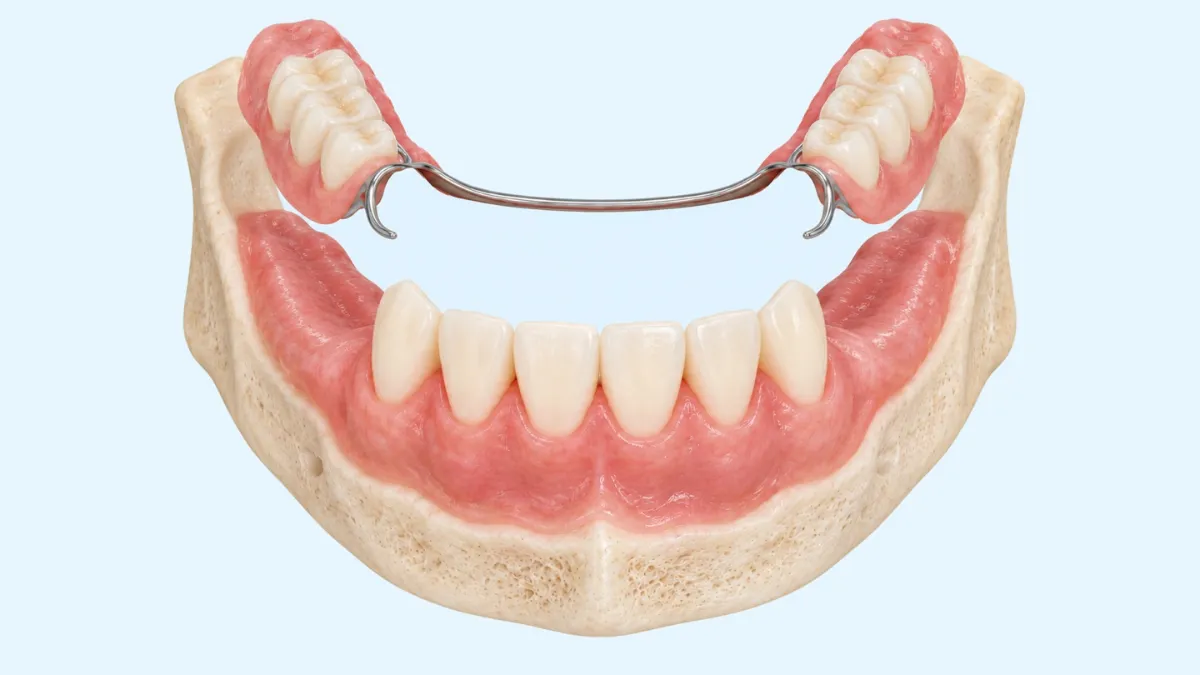
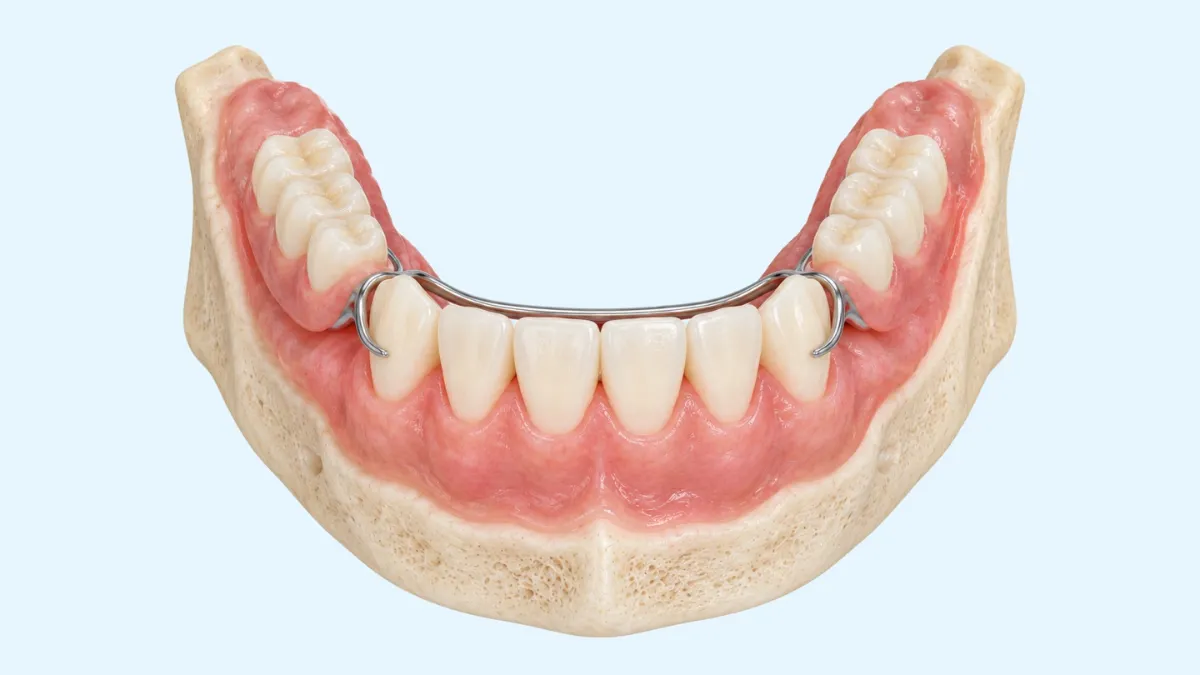
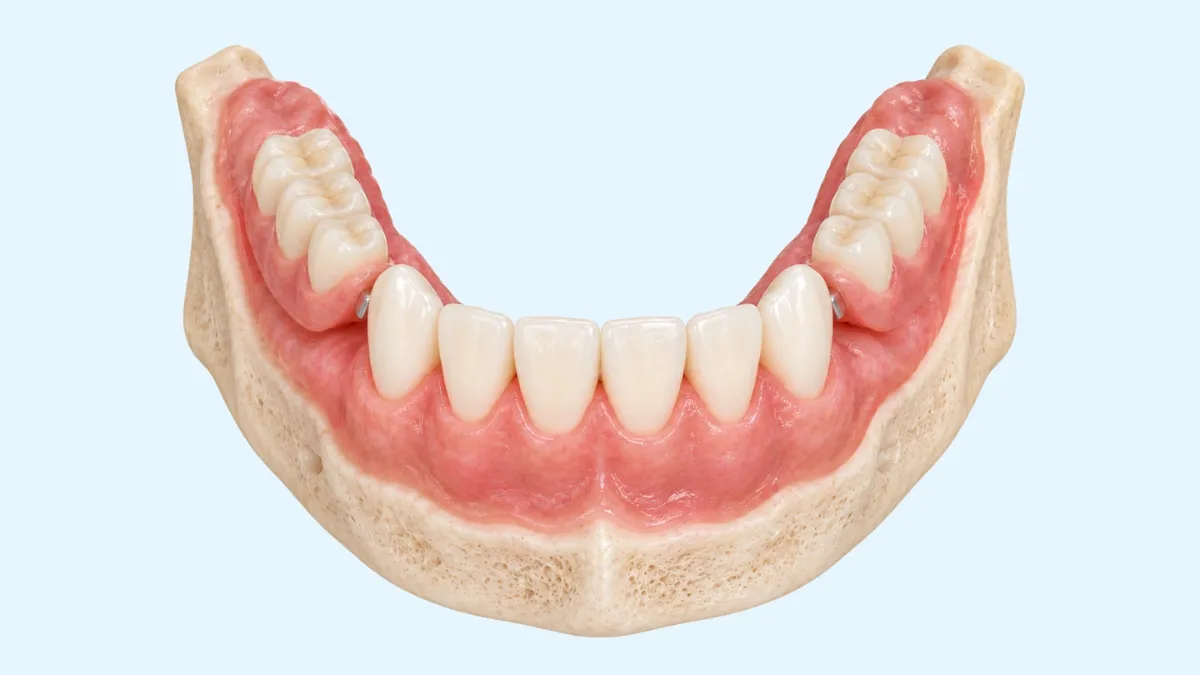
Clasp-retained partial denture
Who it suits: Several gaps, with healthy teeth beside them that can take a clasp.
What it does: A metal-framework partial that holds on to your teeth with thin clasps. Little or no tooth is prepared.

Treatments · Vogue Clinics
A removable denture that fills the gaps between your own teeth and holds on to them.

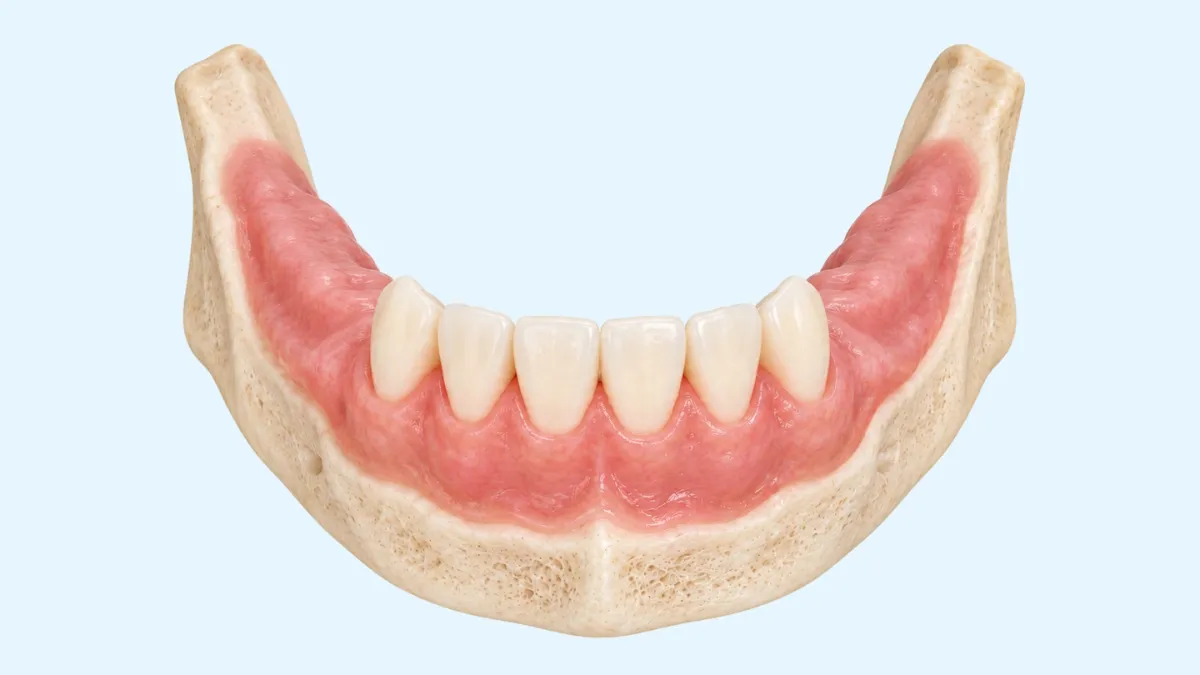
Illustration for explanation only. Which teeth hold the denture, and where clasps or attachments go, is decided from your own examination and measurements.
What is a partial denture, and how does it stay in?
A partial denture is a removable denture that replaces several missing teeth while some of your own remain. It rests on the gum and holds on to your teeth with thin clasps or hidden attachments, and it comes out for cleaning. It suits several gaps, or gaps too long for a bridge.
Which option suits you is decided at your examination, not on this page.
Send photos of your teeth and the gaps, and an X-ray if you have one, on WhatsApp or through the form. Tell us whether you already wear a denture and what bothers you about it.
Sore spots are common at first and are eased at follow-up visits. Clean the denture and your own teeth separately every day, and keep up check-ups, where the supporting teeth are checked for decay and the clasps for fit. Your coordinator stays reachable, and later check-ups can be done by a dentist near your home.
Your dentist suggests a type from the number and position of the gaps and the health of the teeth that will hold it.
A gap isn't only about looks. Neighbouring teeth can tilt into it and the opposite tooth can drift towards it, which changes your bite.
A partial denture is often the simplest and least invasive way to fill several gaps at once. It can also be a step on the way: some patients start with one and move to implants later.
| Option | What it means for you |
|---|---|
| Partial denture | Removable. Little or no filing of your own teeth; clasps may show, and it feels bulkier than fixed options. |
| Bridge | Fixed. The teeth either side of the gap are crowned to hold it, so healthy tooth may be filed down. |
| Implant | Fixed. Leaves neighbouring teeth alone, but needs surgery, enough bone and time to heal. |
| Implant-supported denture | When few teeth are left: implants hold the denture instead of your own teeth. |
The teeth that hold a partial denture work harder, and plaque collects around the clasps. Keeping those teeth healthy is what keeps the denture useful.
A partial denture holds on to your own teeth, and the load is shared between those teeth and the gum. Each part has a job.
| Partial denture | Full denture | |
|---|---|---|
| When | Some of your own teeth remain | No teeth are left in the jaw |
| Held by | Clasps or attachments on your own teeth | Suction and the shape of the gums |
| The palate | An upper partial can often cover less of it | An upper full denture usually covers it |
| Your own teeth | Need extra care, because they carry the denture | None to look after, but the gums still need check-ups |
Your treatment journey
From your first message to the follow-up after you fly home, one coordinator stays with you.
From home
A few smile photos or a recent X-ray on WhatsApp is enough to start.
From home
Our dentists prepare your treatment plan and quote, in writing.
Istanbul
We organise appointments, hotel and transfers around your treatment.
At the clinic
Digital impressions and smile design let you see the plan before anything begins. A coordinator translates in the chair and explains each step.
Back home
Your coordinator stays reachable after you've flown home.
Every dentist at our clinics provides this treatment.

Head Dentist · Founder · Ataşehir and Bağdat Caddesi

Dentist · Branch director, Bağdat Caddesi

Dentist

Dentist · Aesthetic and prosthetic dentistry

Orthodontist

Endodontist

Dentist · Pediatric dentistry

Dentist

Dentist · Bağdat Caddesi

Dentist · PhD programme in Restorative Dentistry

Dentist

Dentist

Pediatric Dentist
Dentist
You can have this treatment at both of our Istanbul clinics: Dental clinic in Ataşehir, Istanbul and Dental clinic in Kadıköy, Bağdat Caddesi.
There is no fixed number of years. A partial denture's life depends mostly on the health of the teeth it holds on to, how well the clasps still fit and how the gums and bone change under the gaps. Metal-framework partials are usually the most durable type, while acrylic ones are often a stopgap. Daily cleaning and check-ups help it last.
Your dentist will usually advise taking it out while you sleep. That gives your gums a break and lets you clean both the denture and the teeth that hold it, where plaque collects around the clasps. Keep it in water or a cleaning solution overnight, and put it back with your fingers rather than biting it into place, which can bend the clasps.
Most people notice the bulk and the clasps at first, especially in the lower jaw, where the tongue moves around them, and sore spots are common early on. It usually eases with practice; start with soft food cut small. A spot that rubs, or hurts when you eat, should be adjusted at a check-up rather than put up with, and don't bend the clasps yourself.
Once a tooth is lost, the bone under the gap slowly shrinks, with or without a denture, so a partial doesn't stop it. A well-fitting denture spreads the load; one that rocks or presses may add to the loss, which is why the fit is checked at check-ups. Implants are the option that usually helps keep the bone.
A well-fitting partial that is kept clean usually doesn't. Problems tend to come from plaque collecting around the clasps, which can lead to decay or gum disease in the supporting teeth, or from a denture that rocks and overloads them. Taking it out to clean every day, and check-ups where the clasps and supporting teeth are examined, keep those teeth healthy.
A flipper is a small acrylic partial, often used as a stopgap while the gums heal after an extraction or before implants. It is thicker and less steady than a metal-framework partial, which is usually thinner, firmer and better for everyday use over a longer period. Your dentist suggests which suits your stage of treatment.
A partial denture takes several appointments. Decay and gum disease are treated first, small rests may be shaped on the supporting teeth, impressions are taken, and the framework and teeth are tried in before the denture is finished and fitted. Precision-attachment dentures take longer because crowns are made first. Your written plan states how many visits you need.
Often, yes. A loose or rubbing denture can be adjusted, a broken tooth or clasp can often be repaired, and a tooth can often be added if you lose another, especially with metal-framework and acrylic dentures. Flexible dentures are harder to adjust or add to. Don't bend clasps or file the denture at home; bring it to us so it is adjusted without damage.
It depends on where the gaps are. The teeth and gum-coloured base are matched to your mouth, and we place clasps where they show least. Near the front, gum-coloured clasps or attachments hidden in crowns are options, so no metal shows when you smile. You see the result at the try-in, before the denture is finished.
Usually not. A partial denture holds on to your own teeth with clasps or attachments, and small rests stop it sinking into the gum, so it normally stays put without adhesive. If it starts to lift or rock, the clasps may need adjusting or the fit may have changed, so bring it to a check-up rather than relying on adhesive.
That depends on the type and on any treatment your own teeth need first. Your written plan states it before you book anything.
This page is for general information and doesn't replace an examination by a dentist.
Start here
A dentist looks at it and we reply with honest options and a written plan. You don't have to commit to anything.
Mon–Sat 09:30–18:30
Get directions