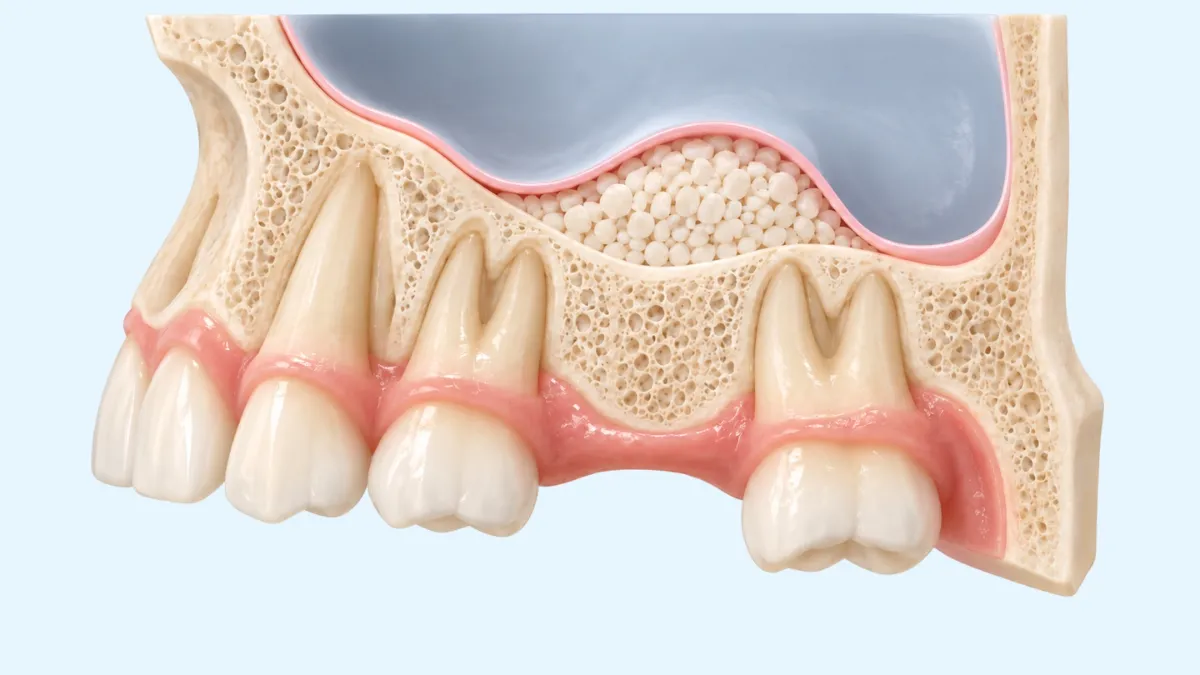
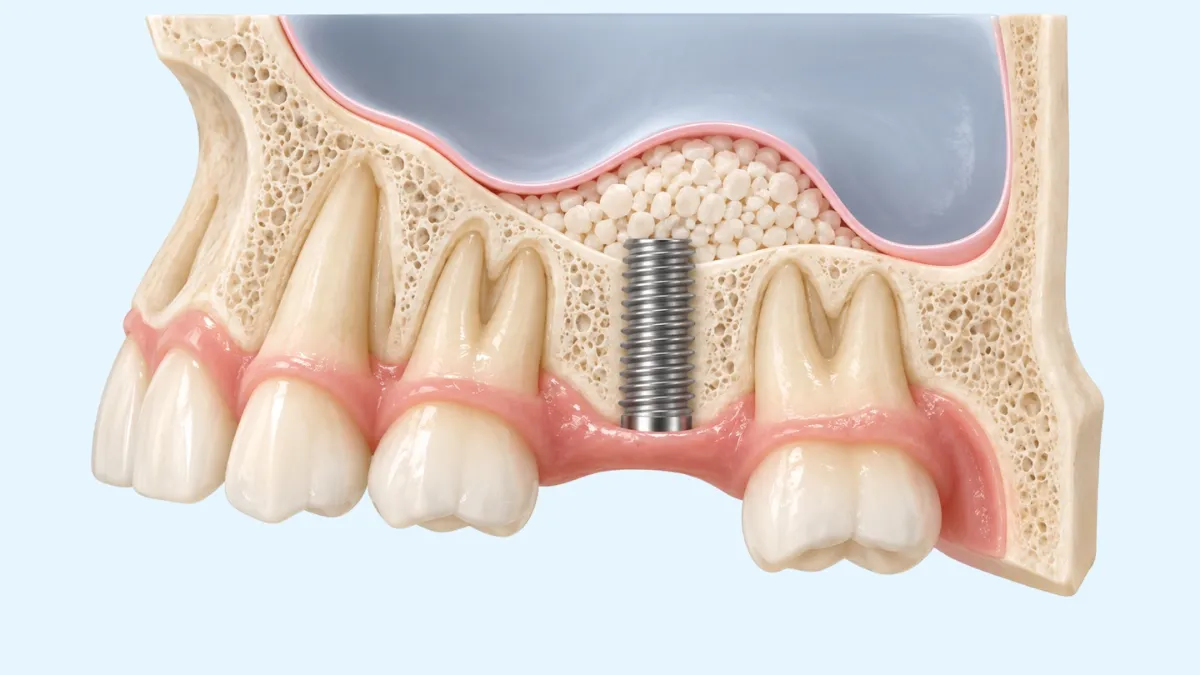
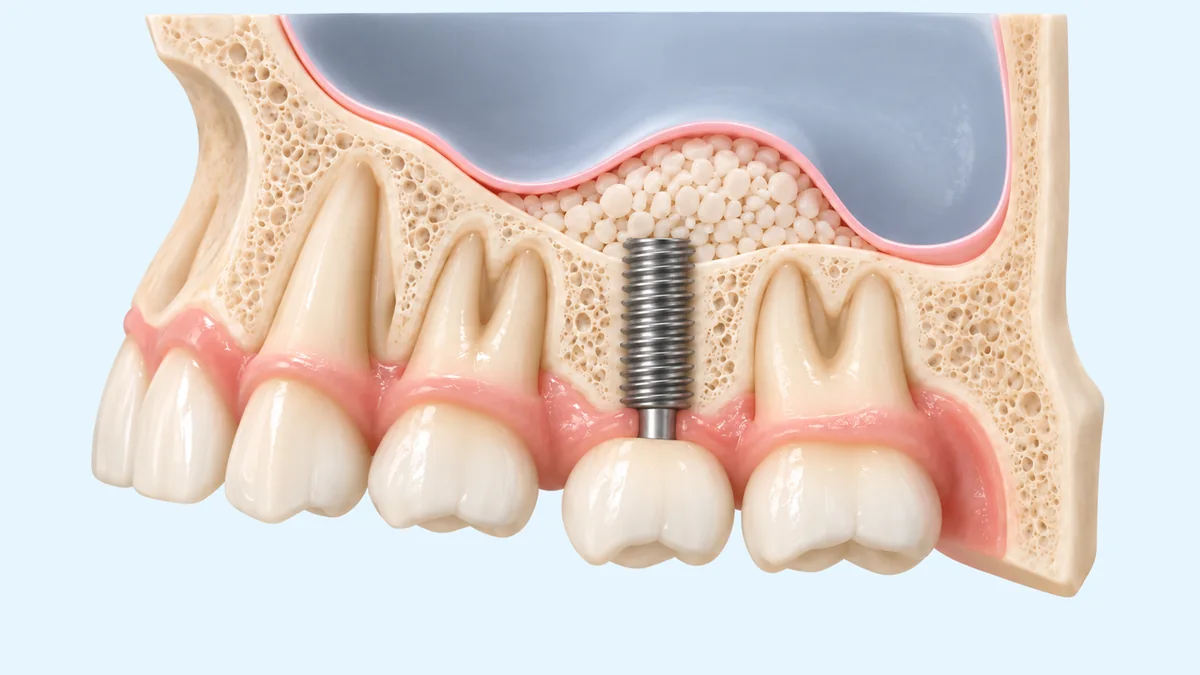
Closed sinus lift
Who it suits: People missing only a little bone height under the sinus.
What it does: The sinus floor is raised through the hole prepared for the implant, which often goes in at the same appointment.

Treatments · Vogue Clinics
Bone is added under the sinus floor so that an implant can be placed in the upper back jaw.

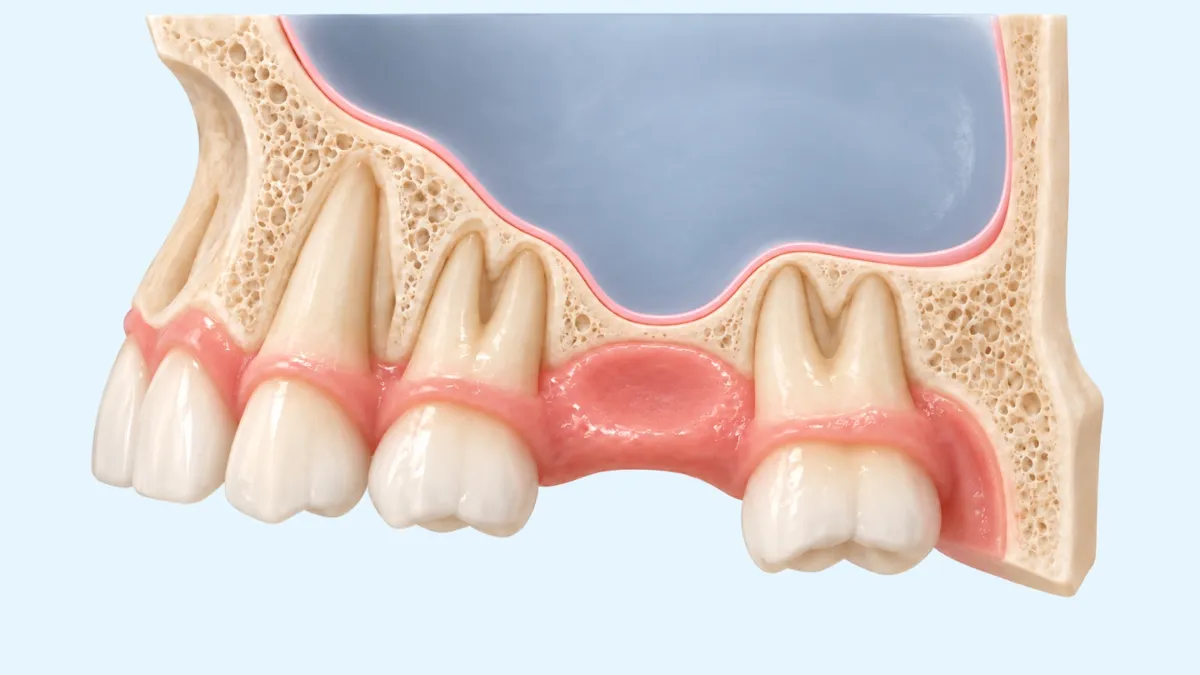
Illustration for explanation only. Your dentist decides from your own 3D scan whether you need a sinus lift, which approach suits you, and whether the implant can go in at the same appointment.
What is a sinus lift and who needs one?
A sinus lift adds bone to the upper back jaw by gently raising the sinus lining and placing graft material beneath it. It is needed when the bone between the mouth and the sinus is too thin to hold an implant, which often happens after back teeth have been missing for some time. A scan shows whether you need one.
Which option suits you is decided at your examination, not on this page.
Send a panoramic X-ray or 3D scan on WhatsApp or through the form, and tell us if another dentist has said you need a sinus lift. Mention any sinus problems. A dentist looks at it before we reply.
Clean around the implant crown every day and tell your dentist about any new sinus symptoms. Routine check-ups can be done by a dentist near your home, and your coordinator stays reachable after you've flown home.
Once an upper back tooth is lost, the bone that held it shrinks, and the sinus above tends to expand into the space. What is left is a thin floor of bone.
There are two main approaches, and the scan decides which one you need. The graft can be your own bone or a bone substitute; your dentist explains which suits you.
Not everyone with missing upper back teeth needs a sinus lift. Depending on the scan, a shorter implant, an implant placed at an angle or an implant in a slightly different position may avoid it.
When bone loss is severe across the whole upper jaw, zygomatic implants anchored in the cheekbone are another option. A bridge on the neighbouring teeth can also be considered if those teeth need crowns anyway.
If you have long-standing sinus problems, tell us. An examination by an ear, nose and throat doctor may be needed before surgery.
The procedure is done under local anaesthesia. Swelling, some bruising on the cheek and a little blood from the nose in the first days are common, and they usually settle. Your dentist tells you which pain relief suits you.
The sinus lining can tear during surgery. A small tear is often repaired on the spot, while a larger one may mean finishing later. Sinus inflammation and a graft that doesn't take are uncommon, and your dentist goes through them with you.
It's best not to. Smoking reduces blood flow to the healing area and raises the chance that the graft doesn't take or the implant doesn't bond. Drawing on a cigarette also creates suction in the mouth, which the healing area doesn't need.
Stopping before the surgery and staying off cigarettes through healing gives the graft its best chance. If you can't stop, tell your dentist; it affects the plan, and they will be straight with you about the risk.
The maxillary sinuses are air spaces in the cheekbones, just above the roots of the upper back teeth. In some people the roots sit very close to the sinus floor, or even push into it.
This is why a toothache in the upper back teeth and sinus pressure can feel alike. Pain there may point to a tooth problem or to sinusitis; an examination confirms which. It is also why the bone under the sinus is checked carefully before an implant.
Your treatment journey
From your first message to the follow-up after you fly home, one coordinator stays with you.
From home
A few smile photos or a recent X-ray on WhatsApp is enough to start.
From home
Our dentists prepare your treatment plan and quote, in writing.
Istanbul
We organise appointments, hotel and transfers around your treatment.
At the clinic
Digital impressions and smile design let you see the plan before anything begins. A coordinator translates in the chair and explains each step.
Back home
Your coordinator stays reachable after you've flown home.
Every dentist at our clinics provides this treatment.
Head Dentist · Founder · Ataşehir and Bağdat Caddesi
Dentist · Branch director, Bağdat Caddesi
Dentist

Dentist · Aesthetic and prosthetic dentistry

Orthodontist
Endodontist

Dentist · Pediatric dentistry

Dentist

Dentist · Bağdat Caddesi

Dentist · PhD programme in Restorative Dentistry

Dentist

Dentist

Pediatric Dentist
Dentist
You can have this treatment at both of our Istanbul clinics: Dental clinic in Ataşehir, Istanbul and Dental clinic in Kadıköy, Bağdat Caddesi.
A sinus lift is a particular kind of bone graft. The sinus lining in the upper back jaw is gently raised and graft material is placed beneath it, adding height where the bone under the sinus is too thin to hold an implant. Other bone grafts add bone elsewhere in the jaw. The graft can be your own bone or a bone substitute, and your scan shows what you need.
No. The lift happens inside the jaw, under the sinus floor, and doesn't change the shape of your nose or face. Your voice doesn't change either. In the first days you may have some swelling and mild bruising on the cheek, which usually settles. The lift itself only adds bone where an implant needs it, and that can't be seen from outside.
It is done under local anaesthesia, so most patients feel pressure rather than pain. Soreness and swelling afterwards are normal and usually ease over the first days; after a closed lift there is typically less swelling than after an open one. Pain that is getting worse rather than better, or comes with a fever, a bad taste or discharge from the nose, is a reason to contact us.
There are two kinds of healing. Swelling and tenderness usually settle over the first days, while the graft takes months to mature into bone. If the implant went in at the same time, both heal together; if not, the implant is placed once the graft has matured. Your dentist tells you when you can return to work, and your written plan gives the timeline.
Pressure changes affect the healing sinus, so you are usually asked to wait longer before flying than after a standard implant. There is no single answer for everyone: it depends on the method used and how the area is healing. Your surgeon tells you when it is safe, and your written plan allows time for it before your return flight.
Wait until your dentist says so. Heavy exercise and lifting raise pressure and can strain the healing area, and swimming and diving expose the sinus to pressure changes. The wait for these is usually longer than after a standard implant, and it depends on the method used and how you are healing. Ask at your check-up before you start again.
Occasionally. The roots of the upper back teeth sit just below the sinus, so implants in that area are planned on a 3D scan to keep them clear of it, or bone is added first with a sinus lift. After a sinus lift, sinus inflammation can occur but is uncommon. Tell us about any long-standing sinus trouble beforehand; an ear, nose and throat check may be advised.
Most people heal well, but like any surgery it carries risks. Swelling, mild bruising and a little bleeding from the nose are common in the first days. The thin sinus lining can tear during surgery; a small tear is often repaired on the spot. Sinus infection and a graft that doesn't take are uncommon, and your dentist goes through these with you before you decide.
It isn't expected to. The work is done under the sinus floor, inside the jaw, not in the nasal passages. In the first days a little bleeding from the nose is common, and you are asked not to blow your nose hard and to sneeze with your mouth open. If you have long-standing sinus problems, tell us before surgery, as an ear, nose and throat check may help.
Yes. Sinus lift and sinus augmentation are two names for the same procedure: the sinus lining in the upper back jaw is raised and graft material is placed beneath it, so there is enough bone for an implant. It can be done through the implant site (a closed lift) or through a small window in the side of the jaw (an open lift).
Pressure changes affect the healing sinus, so you are usually asked to wait longer than after a standard implant. Your surgeon tells you when it is safe, and your written plan allows for it.
This page is for general information and doesn't replace an examination by a dentist.
Start here
A dentist looks at it and we reply with honest options and a written plan. You don't have to commit to anything.
Mon–Sat 09:30–18:30
Get directions