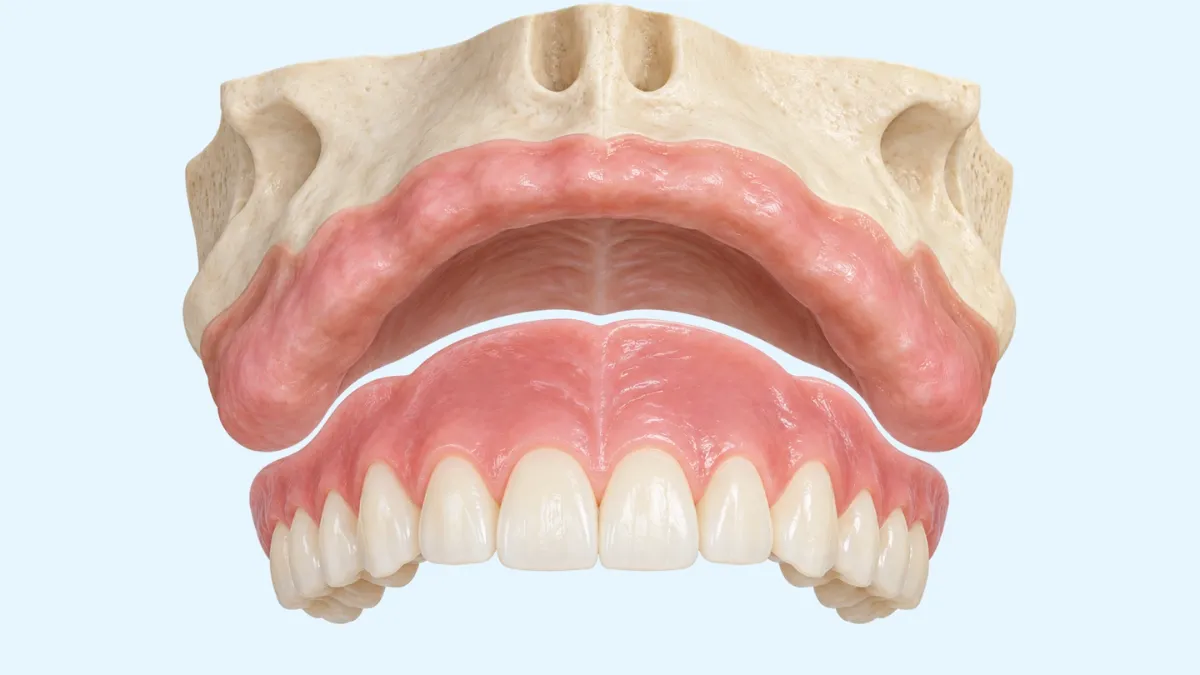
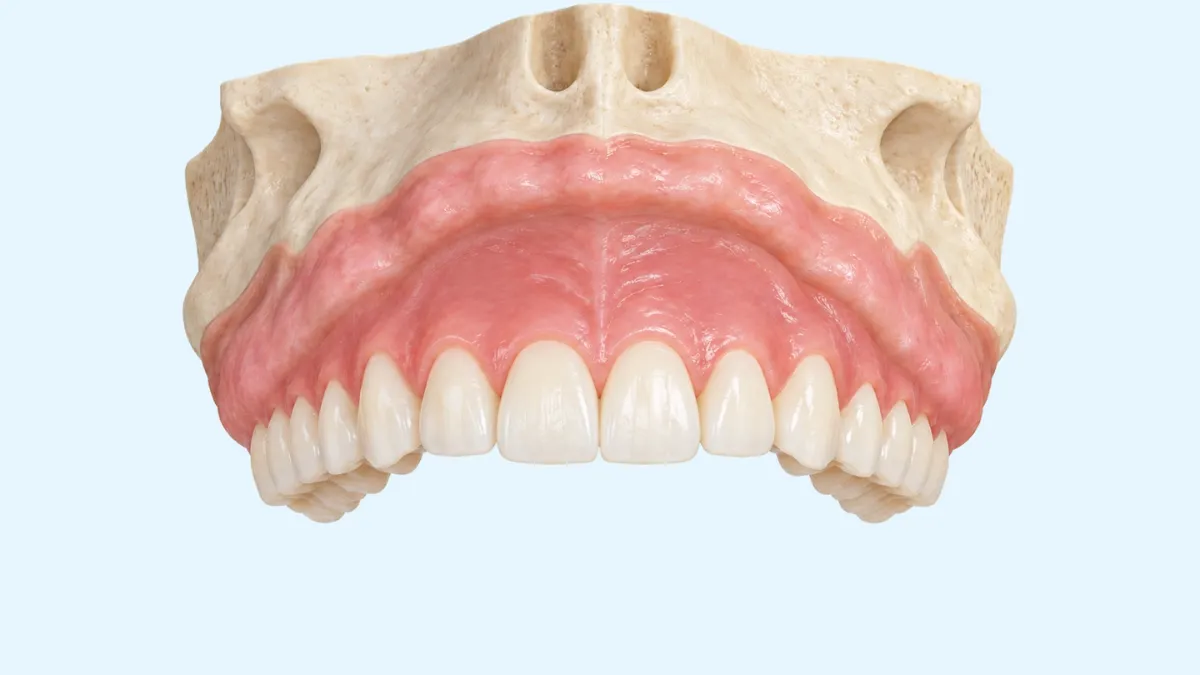
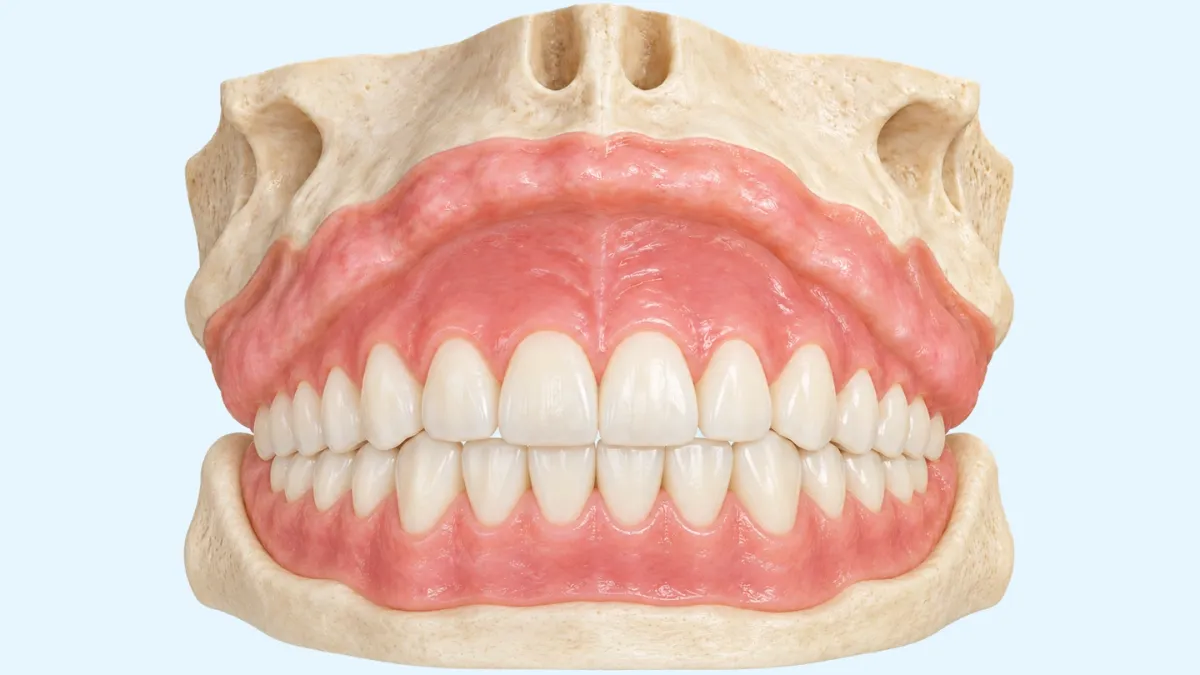
Conventional full denture
Who it suits: A jaw that has healed after extractions, for people who would rather avoid surgery.
What it does: A removable denture held by suction and the shape of the gums, made over several visits with a try-in.

Treatments · Vogue Clinics
A removable set of teeth for a jaw with no teeth left, made to fit your gums, bite and face.

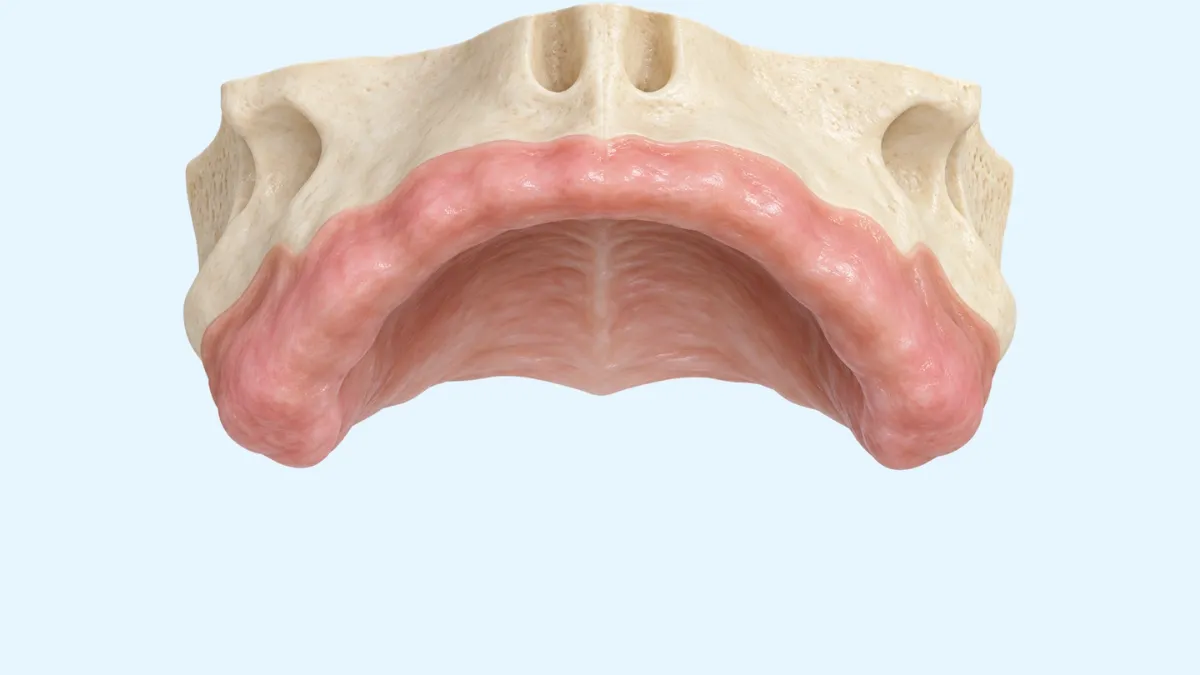
Illustration for explanation only. The shape of your denture and how the teeth are set are planned from your own measurements and bite.
What are full dentures and who are they for?
Full dentures, also called complete dentures, replace all the teeth in the upper or lower jaw. They rest on the gums, the upper one also on the palate, and you take them out to clean them. They suit people with no teeth left in a jaw, or teeth that can't be saved. Implants can make them steadier.
Which option suits you is decided at your examination, not on this page.
Send a photo of your smile, and of your current denture if you have one, on WhatsApp or through the form. Tell us what bothers you: a loose fit, sore spots or the way it looks.
A denture is built step by step, and you see it before it's finished. How many visits it takes depends on your case; your written plan states it.
An upper denture covers the palate, which usually gives it good suction. A lower denture sits on a narrower ridge, with the tongue and cheeks moving around it, so most people find it harder to keep in place.
Over the years the bone under a denture slowly shrinks, so a well-fitting denture can start to rock; a reline or a new denture restores the fit. If a lower denture still won't stay put, ask about implants. They need enough bone and a surgical step, and your dentist tells you whether they suit you.
| Complete denture | Implant-supported denture | |
|---|---|---|
| Held by | Suction and the shape of your gums | Implants in the jawbone |
| Surgery | Not needed | Needed to place the implants |
| Steadiness | A lower denture often moves when you chew | Usually steadier, especially in the lower jaw |
| Cleaning | Taken out and cleaned | Snap-in types come out; fixed ones are cleaned in place |
Most people need some time with a new denture. Much of it settles by itself; a few things need a visit.
With a conventional upper denture, usually yes. The wide contact with the palate is what gives it suction; without it, most upper dentures would drop.
Some people find that covering the palate changes how food tastes or feels bulky at first, and most get used to it. If you can't, an upper denture held by implants can often be made with less of the palate covered, or none; your dentist tells you whether your bone allows it.
If some healthy teeth remain, keeping them is often worth it. They can hold a partial denture, and they help keep the bone around them.
If the remaining teeth are loose from gum disease, badly decayed or can't be saved, a full denture may be the steadier long-term plan. Your dentist explains tooth by tooth which can be kept, and why.
Your treatment journey
From your first message to the follow-up after you fly home, one coordinator stays with you.
From home
A few smile photos or a recent X-ray on WhatsApp is enough to start.
From home
Our dentists prepare your treatment plan and quote, in writing.
Istanbul
We organise appointments, hotel and transfers around your treatment.
At the clinic
Digital impressions and smile design let you see the plan before anything begins. A coordinator translates in the chair and explains each step.
Back home
Your coordinator stays reachable after you've flown home.
Every dentist at our clinics provides this treatment.

Head Dentist · Founder · Ataşehir and Bağdat Caddesi

Dentist · Branch director, Bağdat Caddesi

Dentist

Dentist · Aesthetic and prosthetic dentistry

Orthodontist

Endodontist

Dentist · Pediatric dentistry

Dentist

Dentist · Bağdat Caddesi

Dentist · PhD programme in Restorative Dentistry

Dentist

Dentist

Pediatric Dentist
Dentist
You can have this treatment at both of our Istanbul clinics: Dental clinic in Ataşehir, Istanbul and Dental clinic in Kadıköy, Bağdat Caddesi.
There is no fixed number of years. The bone under a denture slowly shrinks and the teeth wear, so even a well-made denture gradually loosens. A reline refits it to your gums as they are now; when the teeth are worn or the base is damaged, a new denture is the better answer. Regular check-ups catch these changes early, even with no teeth of your own.
A full denture is held by suction and by the shape of the gum ridge it rests on. An upper denture usually holds well because it also covers the palate, giving it a large contact area. A lower denture sits on a narrower ridge with the tongue and cheeks moving around it, so it often feels less steady. A little adhesive can help; needing more and more means the fit has changed.
A full denture is made over several appointments: impressions and a record of your bite, a try-in with the teeth set in wax, then fitting. The first adjustments come once you have worn it for a while. If teeth need removing first, the gums are usually allowed to heal before the final denture is made. Your written plan states how many visits you need.
A conventional full denture is removable: you take it out to clean it, and it can't be permanently fixed in on its own. If you want something steadier, a denture can clip onto implants and still be taken out. If you want teeth that don't come out at all, a fixed set on implants, such as All-on-4, is the option. Both need surgery and enough bone.
Dentists usually advise taking your denture out while you sleep, so your gums get a rest, and keeping it in water or a cleaning solution, since a denture left to dry can lose its shape. Brush it gently every day over a basin filled with water, so it doesn't break if dropped, and avoid hot water, which can warp it.
Usually, yes. Gum disease is a common reason teeth are lost; teeth that can't be saved are removed, and the gums are allowed to heal before the final denture is made. If some healthy teeth remain, keeping them to support a partial denture may be the better plan. Your dentist checks your gums and any remaining teeth at the examination.
Not necessarily. A full denture replaces all the teeth in one jaw, so you can have one for the upper jaw, the lower jaw or both. If one jaw still has teeth, only the other needs a full denture; the denture teeth are then set to meet your natural teeth, and your dentist checks that those opposite teeth are healthy.
Yes. We choose the shape, size and shade of the teeth to suit your face, and you see them set in wax at the try-in, where the look, your speech and your bite are checked together. Changes are made before the denture is finished. Bring your old denture if you have one, and tell us what you liked or disliked about how it looked.
A full denture is usually made of artificial teeth set in a gum-coloured acrylic base, shaped to your gums and your bite. A conventional full denture normally contains no metal. If you have a known allergy, tell your dentist before planning, and ask about the materials listed in your written plan.
Often, yes. An immediate denture is made beforehand and fitted straight after the extractions, so you aren't left without teeth. As the gums heal they change shape, so this denture usually needs relining or replacing later. Your dentist explains at the examination whether an immediate or a conventional denture suits you.
A denture is made over several appointments, and the first adjustments come after you've worn it for a while. How many visits it takes depends on your case; your written plan states it.
This page is for general information and doesn't replace an examination by a dentist.
Start here
A dentist looks at it and we reply with honest options and a written plan. You don't have to commit to anything.
Mon–Sat 09:30–18:30
Get directions