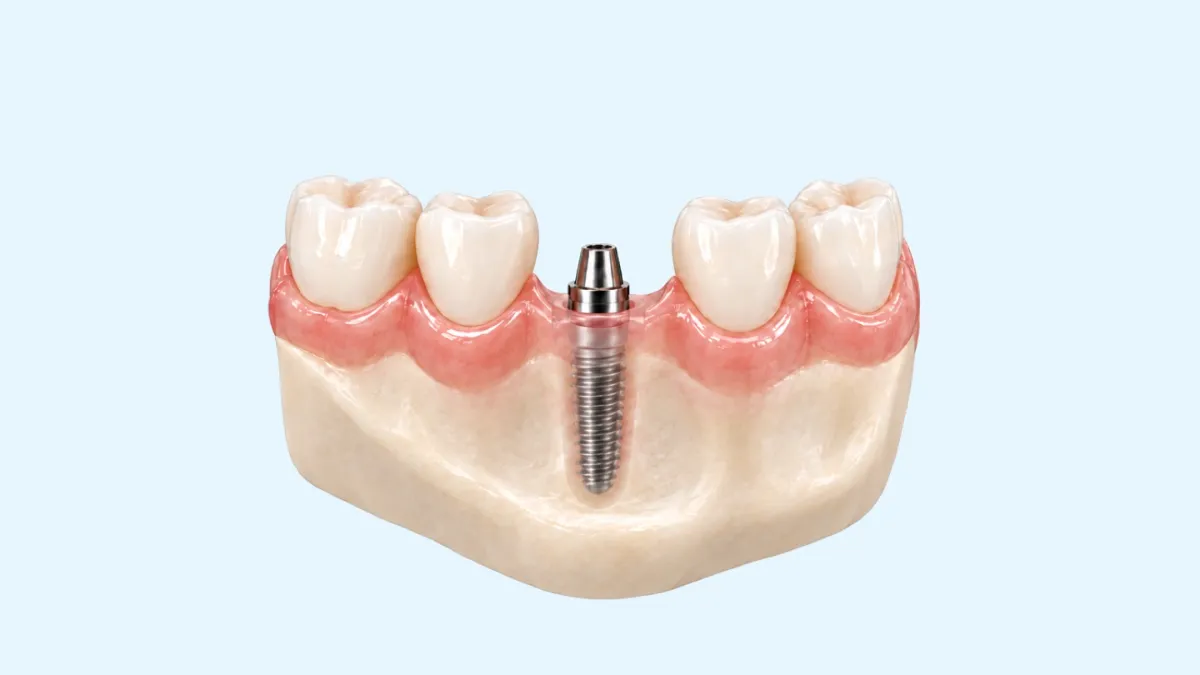
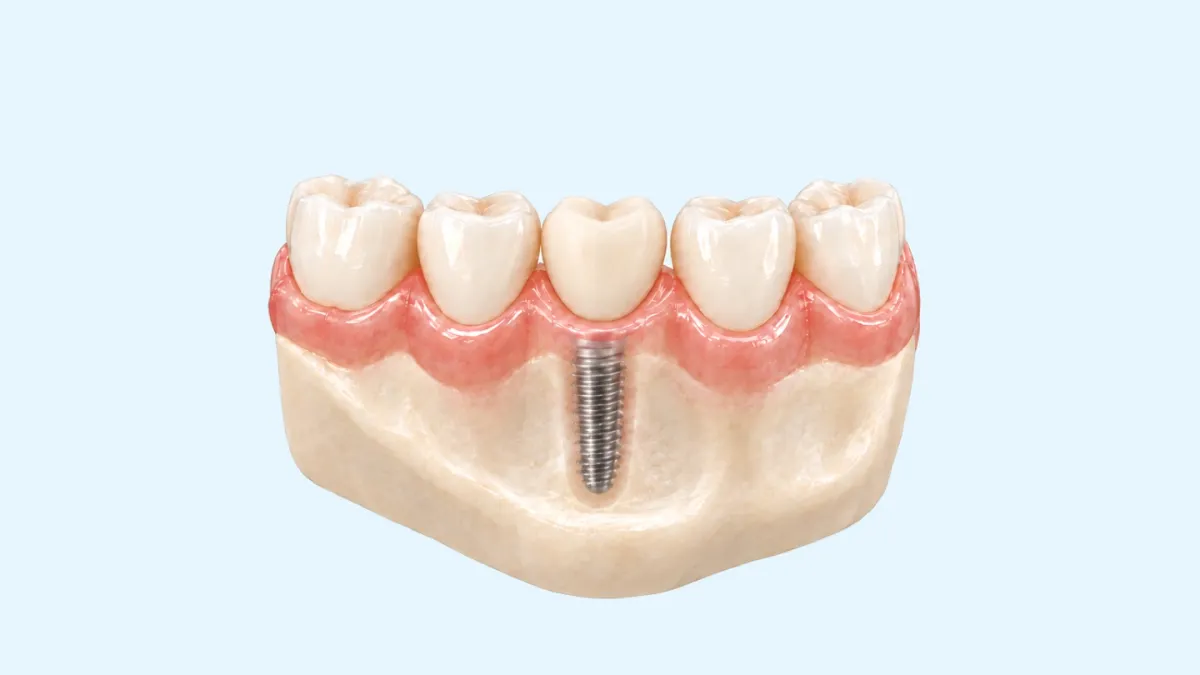
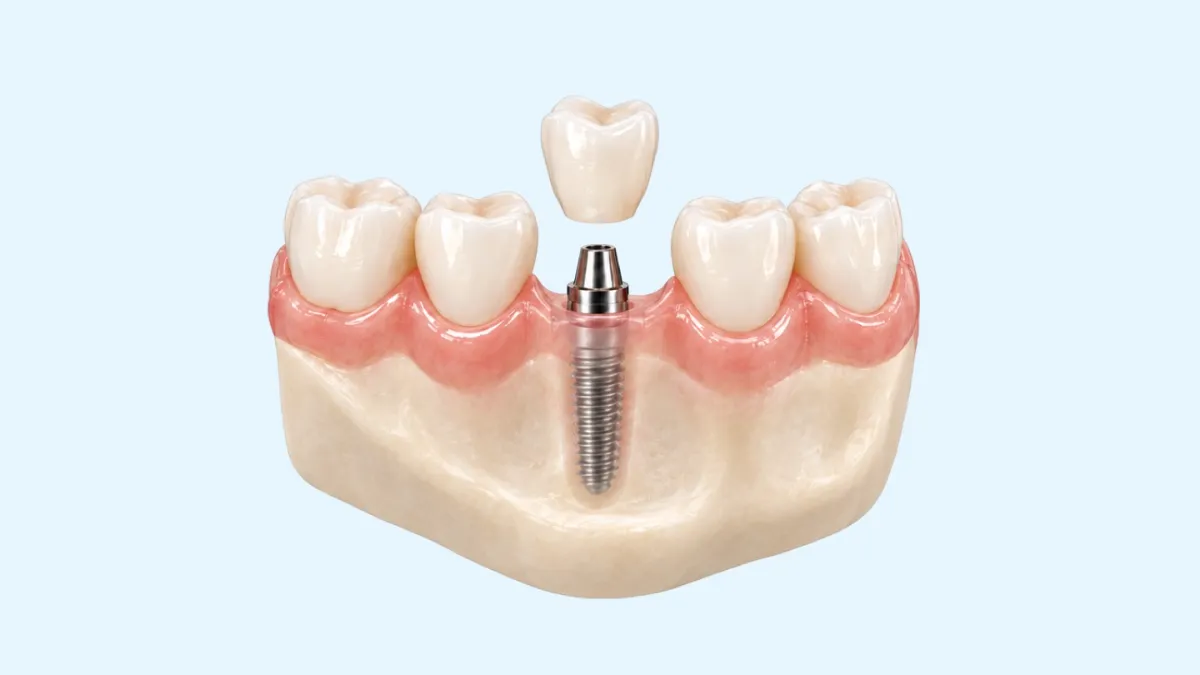
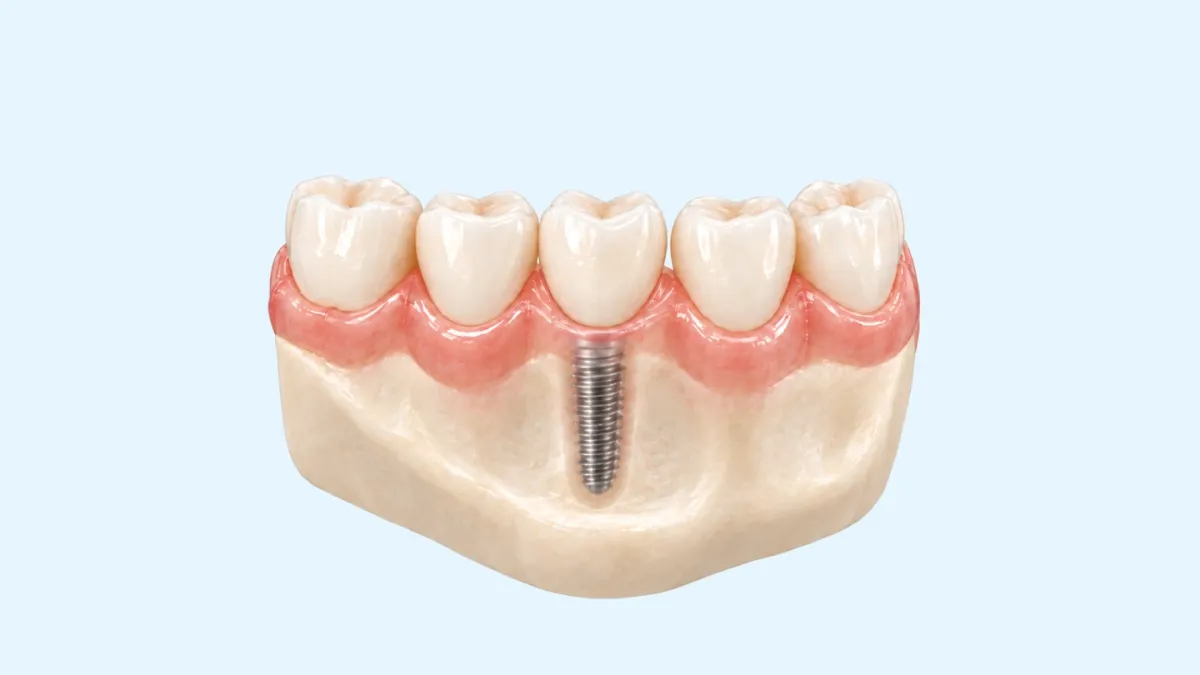
Single implant
Who it suits: People missing one tooth whose neighbouring teeth are healthy.
What it does: One implant and one crown replace the tooth without touching the teeth beside it.

Treatments · Vogue Clinics
A fixed replacement for one tooth or several, placed in two visits.

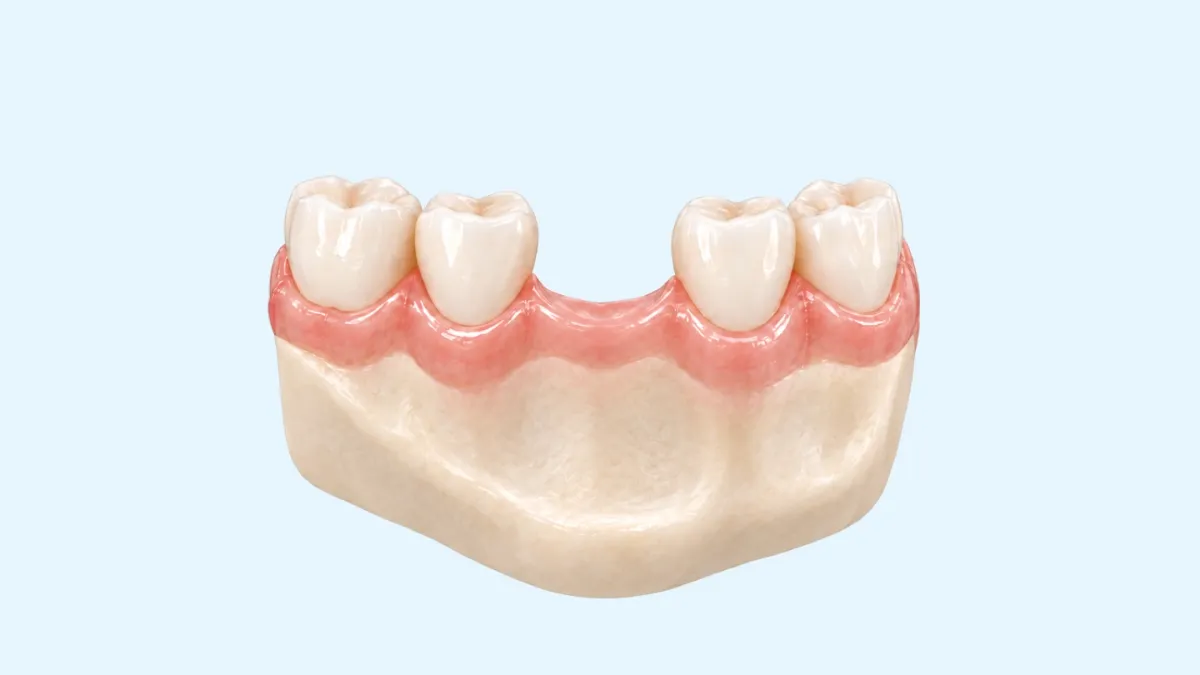
Illustration for explanation only. Your dentist plans each implant from your own imaging.
How long do dental implants take in Istanbul?
Most patients make two visits. At the first, the implant is placed and you leave with a temporary tooth where possible. The bone then bonds with the implant, typically over three to six months, and the final crown is fitted at the second visit. A bone graft or a sinus lift can lengthen this.
Which option suits you is decided at your examination, not on this page.
Send a few photos of your smile, or a recent panoramic X-ray if you have one, on WhatsApp or through the form. Tell us which teeth are missing and for how long. A dentist looks at them before we reply.
Over the following months the bone grows onto the surface of the implant and holds it firmly. Dentists call this osseointegration. It can't be hurried, and the final crown is only made once it is complete. If you needed a bone graft, this takes longer.
Your coordinator stays in touch, and you can send a photo or a question at any time.
Daily cleaning and regular check-ups keep an implant healthy. Routine check-ups can be done by a dentist near your home, and your coordinator stays reachable after you've flown home.
This is the question we hear most often at the first consultation. The placement itself is done under local anaesthesia, so most patients describe pressure rather than pain.
Some swelling and soreness over the following days is normal. Your dentist will tell you which pain relief suits you and what to watch for.
Some soreness and swelling in the first days is normal and usually settles. How much depends on how many implants were placed and whether a graft was needed. Your dentist gives you instructions for your own case.
Contact us if the swelling keeps getting worse instead of settling, you have a fever, bleeding doesn't stop with gentle pressure, numbness in your lip or chin doesn't wear off, or the healing cap or a temporary tooth feels loose.
| Everyday life | When |
|---|---|
| Soft, cool food | From the first day |
| Work and daily routine | When you feel ready; many people rest at first |
| Exercise and heavy lifting | When your dentist says so |
| Chewing on that side | Gently, as your dentist advises |
| Normal chewing on the new tooth | After the final crown is fitted |
Bone volume, gum health, smoking and some medical conditions all affect the outcome. We ask for your medical history early for this reason.
If imaging shows that a simpler option would serve you better, we will say so before you book a flight.
Placing an implant is surgery, even for a single tooth. Most people heal well, but that isn't the same as no risk. Your dentist goes through this list with you before you decide.
Often yes, but not while the gum disease is active. Gum disease (periodontitis) is an infection of the gum and the bone that holds the teeth. The same bacteria can attack the bone around an implant, so the gums are treated and brought under control first.
An implant doesn't cure gum disease. It replaces a tooth that was lost, but the remaining teeth still need treatment and care. People who lost teeth to gum disease can do well with implants, as long as they keep up with cleaning and check-ups.
This is the order most of our patients with gum disease follow:
Much like a natural tooth, with extra care at the gumline. An implant can't decay, but plaque left around it can inflame the gum and bone that hold it. Your dentist shows you the tools that fit your implant at the crown fitting.
Your treatment journey
From your first message to the follow-up after you fly home, one coordinator stays with you.
From home
A few smile photos or a recent X-ray on WhatsApp is enough to start.
From home
Our dentists prepare your treatment plan and quote, in writing.
Istanbul
We organise appointments, hotel and transfers around your treatment.
At the clinic
Digital impressions and smile design let you see the plan before anything begins. A coordinator translates in the chair and explains each step.
Back home
Your coordinator stays reachable after you've flown home.
Results vary from person to person. Your treatment is decided after a clinical examination.
Dental implants
Dental implants
I have had the best service. I have a few crowns and implant placed. This meant me coming to Istanbul twice. The service is exceptional, the co ordinator was efficient, the clinic is clean, the staff was polite and friendly and the quality of the crowns and implants used was exceptional. I came during the offer period and they kindly extended this finish my treatment at a later stage. I highly recommend the clinic and would come back in future if there is a need for further dental treatment.
Staff were amazing e They responded very quickly to any questions I had and were very professional. Sales and consultation: Berin and coordinator: Umut, Merve took care of me from start to finish. I did a tooth implant, The dentist Oğuz was swift and pain free.
Great experience!
Great experience from the moment I arrived in Istanbul, the clinic was great, professional and always here to help at every stage. I am happy with my crowns and my implants.
Could not have gone anywhere better than the clinic
I have had the best experience ever my teeth were falling out I researched many company's and talked to a lot of people from those companies however speaking to Berin I new the clinic where who I'd come to everyone of the staff are fabulous you couldn't ask for better people to look after you my dentists where great very skilled I had no pain all my teeth where removed and all on six implants put in I love them thank you Berin Asude and Hava and everyone at the clinic l'll never forget you all
Great service
Thankyou to Deniz for getting all 3 of us in at late notice for 3 separate treatments thanks to Asude for looking after us and making sure everything's going ok thankyou to my dentist Atakan Always great service from having a filling, to crowns or implants we are always well looked after 5 star service keep up the good work
The clinic is a great place to get your teeth done!
The clinic is a great place to get your teeth sorted out! Despite the language barrier at times, the staff are friendly and always willing to help. Thank you to Deniz who manages the whole process from beginning to end. I am very happy with my new implant and I can confirm that my family could not tell which tooth was not real
Every dentist at our clinics provides this treatment.

Head Dentist · Founder · Ataşehir and Bağdat Caddesi

Dentist · Branch director, Bağdat Caddesi

Dentist

Dentist · Aesthetic and prosthetic dentistry

Orthodontist

Endodontist

Dentist · Pediatric dentistry

Dentist

Dentist · Bağdat Caddesi

Dentist · PhD programme in Restorative Dentistry

Dentist

Dentist

Pediatric Dentist
Dentist
You can have this treatment at both of our Istanbul clinics: Dental clinic in Ataşehir, Istanbul and Dental clinic in Kadıköy, Bağdat Caddesi.
Neither is better for everyone; it depends on how many teeth are missing, your bone and your health. Implants are anchored in the jaw, stay fixed and don't rest on the gum, but they need surgery and a healing period. Dentures need no surgery and come out to clean, though a lower denture often moves. A denture that clips onto a few implants sits between the two.
There is no fixed number of years, but a well-cared-for implant can last for many years. Daily cleaning, regular check-ups, smoking and teeth grinding make the biggest difference. The crown on top may chip or loosen over time and can usually be repaired without touching the implant. If the gum and bone around an implant become inflamed, the implant itself is at risk, which is what check-ups are for.
The implant itself is placed at one appointment, and where possible you leave with a temporary tooth the same day. The final crown can't be fitted on day one: the bone first has to bond with the implant, typically over three to six months. Whether a same-day temporary is possible for you depends on the bone and where the gap is, and your plan states it.
Most dental implants are made of titanium or a titanium alloy, the implant material with the longest research record. For people who want no metal, or for front teeth where thin gum could let a grey edge show, implants made of white zirconia ceramic are an option. The crown you see is a separate part, made to match your other teeth, and a titanium implant can carry a zirconia crown too.
Dental implants are generally not a reason to avoid an MRI scan. Titanium and zirconia are not magnetic, although metal parts in the mouth can cause some distortion in images of the head and jaw. Tell the radiology team that you have implants, and bring any details your dentist gave you, so they can plan the scan with that in mind.
It is uncommon, and the cause decides what happens next. Early on, the bone sometimes doesn't bond with the implant, which then has to be removed; smoking and uncontrolled diabetes make this more likely. Years later, inflammation from plaque can weaken the bone around it. Often what feels loose is actually the crown or its small screw, which can usually be fixed without touching the implant.
In most cases, yes. The implant sits inside the bone and can't be seen; what you see is the crown, made to match the colour and shape of the teeth beside it, and you see it in your mouth before it is fixed. At the front, where the gum is thin, your dentist also considers the gum line, and a white zirconia implant is sometimes chosen there.
No. An implant and its crown aren't natural tooth, so they can't decay. They still need daily cleaning, because plaque left around an implant can inflame the gum and bone that hold it, a condition called peri-implantitis. The natural teeth next to an implant can still get cavities, so brushing, cleaning between the teeth and check-ups matter as much as before.
Yes, a dentist can remove an implant, but only when there is a reason, such as an implant that hasn't bonded with the bone or one with serious bone loss around it. Removing a healthy implant is rarely advised, because bone comes away with it. Once the area has healed, a new implant can often be placed, sometimes after a bone graft.
It depends on your case, and your dentist tells you. A denture often has to be adjusted first, so that it doesn't press on the healing implants. In many cases you won't be without teeth while they heal: your plan states whether a temporary tooth, a temporary bridge or your adjusted denture is possible for you.
Your surgeon will tell you when it's safe to fly. If you've had a sinus lift, you may be asked to wait longer.
This page is for general information and doesn't replace an examination by a dentist.
Start here
A dentist looks at it and we reply with honest options and a written plan. You don't have to commit to anything.
Mon–Sat 09:30–18:30
Get directions