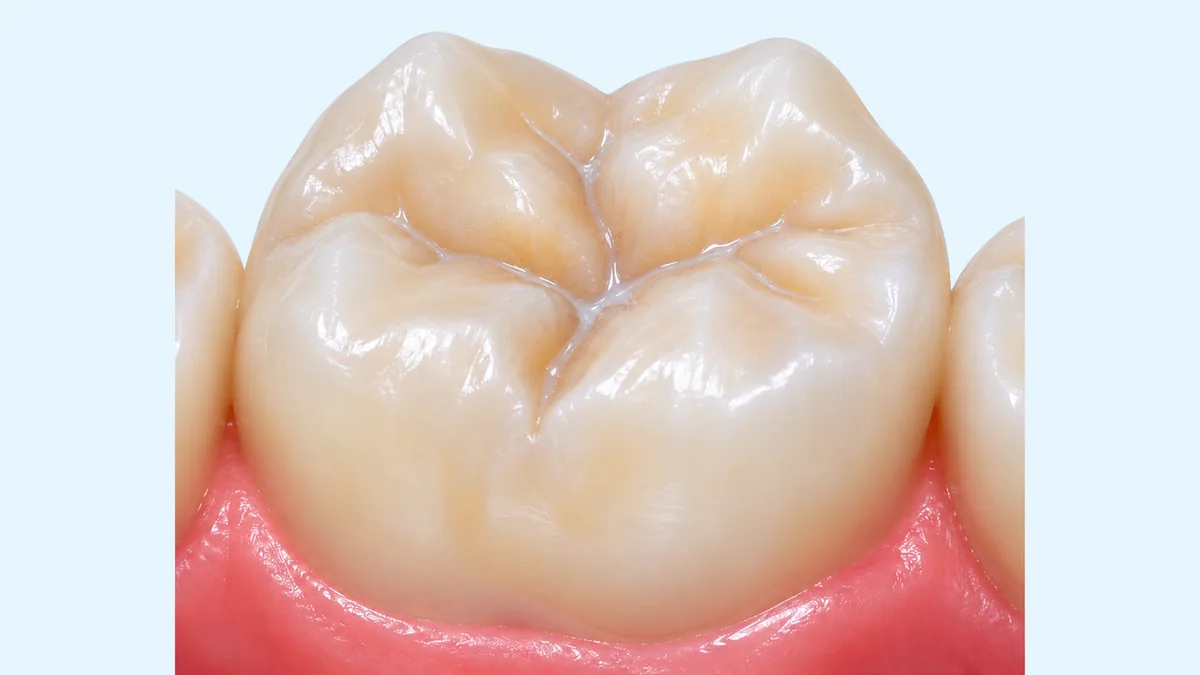
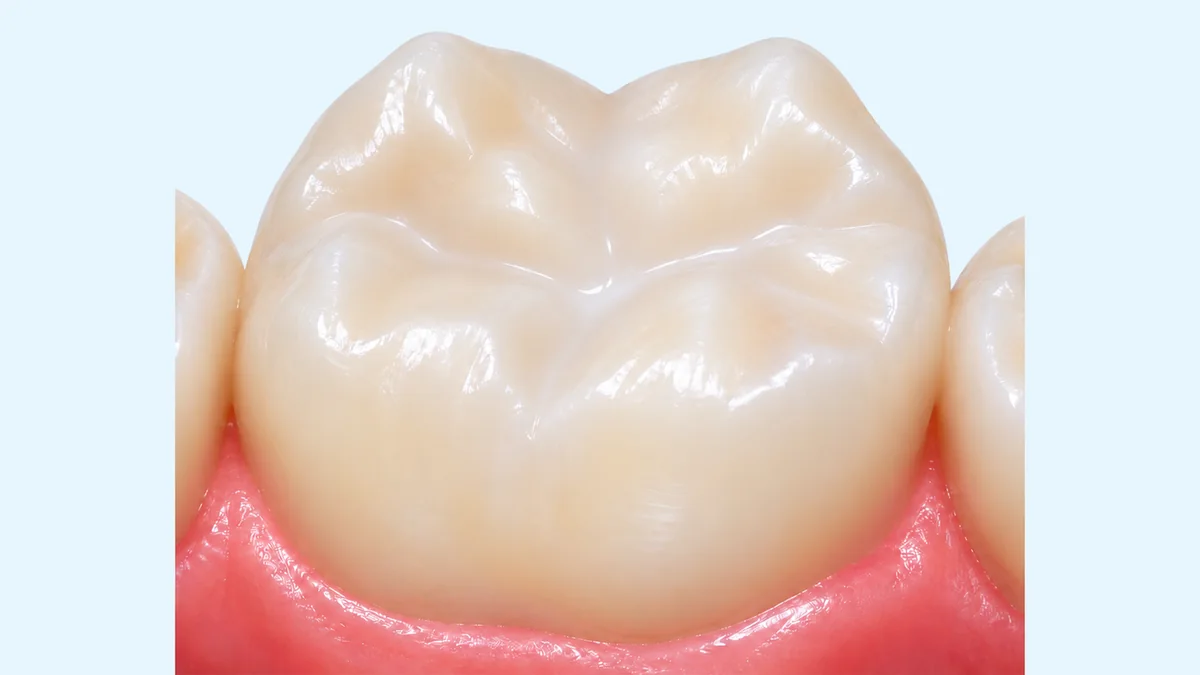
Fissure sealant
Who it suits: Back teeth with deep grooves that are still free of decay.
What it does: A thin coating closes the grooves on the chewing surface, with no drilling, so food and bacteria can't settle in them.

Treatments · Vogue Clinics
A thin protective coating painted into the grooves of back teeth to help keep decay out.

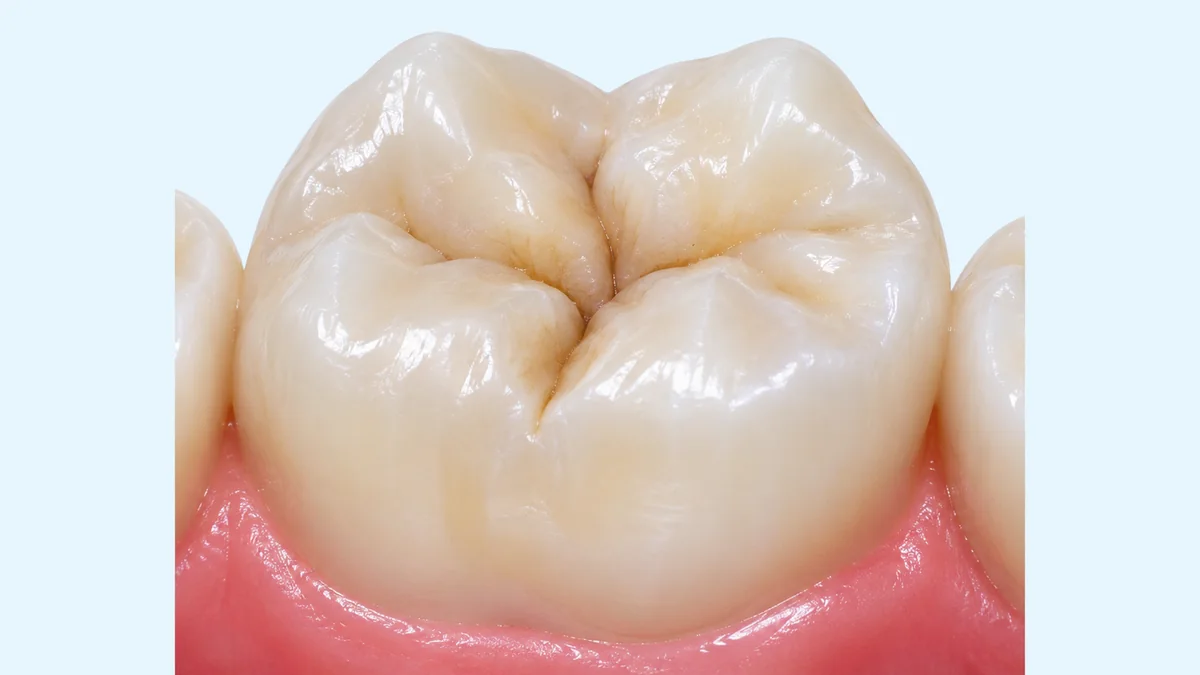
Illustration for explanation only. Whether a tooth needs a sealant depends on how deep its grooves are and on your child's decay risk, which our dentist checks at the examination.
What are dental sealants, and does my child need them?
Dental sealants, also called fissure sealants, are a thin coating that fills the deep grooves on the chewing surfaces of back teeth, where food and bacteria collect and a toothbrush struggles to reach. They are usually placed soon after the adult back teeth come through. Our children's dentist suggests them based on groove depth and your child's decay risk.
Which option suits you is decided at your examination, not on this page.
Write to us on WhatsApp or through the form. Tell us your child's age, whether the back teeth have come through and whether there have been fillings before. A photo of the back teeth helps if your child lets you take one.
It is one of the easiest treatments for a child: there is usually no numbing and no drilling. What matters most is keeping the tooth dry, so we may use cotton rolls or a small suction tip while we work.
Your child can eat and drink as normal afterwards.
They work in different places, so they are often used together rather than one instead of the other.
| Question | Fissure sealant | Fluoride |
|---|---|---|
| What it does | Seals the grooves so food and bacteria can't settle in them | Strengthens enamel and helps early weak spots harden again |
| Where it works | Chewing surfaces of back teeth | All tooth surfaces, including between the teeth |
| How it's applied | Painted into the grooves and set with a light | Painted on as a varnish or gel |
| How often | Once, then checked and topped up at check-ups | Repeated; how often depends on decay risk |
A sealant protects only the chewing surface. Decay between the teeth, and decay from frequent sugary snacks and drinks, still needs brushing, flossing and fluoride toothpaste. If a groove already has a cavity, it needs a filling instead.
The best time is soon after a back tooth has come through, before decay has had a chance to start in its grooves. The tooth needs to be far enough out of the gum to be kept dry while the sealant goes on.
If gum still covers part of the tooth, our dentist may wait, or use a temporary coating until the tooth can be sealed properly.
Your treatment journey
From your first message to the follow-up after you fly home, one coordinator stays with you.
From home
A few smile photos or a recent X-ray on WhatsApp is enough to start.
From home
Our dentists prepare your treatment plan and quote, in writing.
Istanbul
We organise appointments, hotel and transfers around your treatment.
At the clinic
Digital impressions and smile design let you see the plan before anything begins. A coordinator translates in the chair and explains each step.
Back home
Your coordinator stays reachable after you've flown home.
Every dentist at our clinics provides this treatment.

Head Dentist · Founder · Ataşehir and Bağdat Caddesi

Dentist · Branch director, Bağdat Caddesi

Dentist

Dentist · Aesthetic and prosthetic dentistry

Orthodontist

Endodontist

Dentist · Pediatric dentistry

Dentist

Dentist · Bağdat Caddesi

Dentist · PhD programme in Restorative Dentistry

Dentist

Dentist

Pediatric Dentist
Dentist
You can have this treatment at both of our Istanbul clinics: Dental clinic in Ataşehir, Istanbul and Dental clinic in Kadıköy, Bağdat Caddesi.
It varies from child to child, because chewing can wear a sealant down or chip part of it over time. Our dentist checks every sealant at each visit and repairs or tops it up if part has come away. A tooth that has already been sealed isn't redone from scratch; it is simply monitored. If your child notices a rough spot, bring the check-up forward.
Sealants are widely used in children's dentistry and are considered safe in the small amounts placed. Questions about BPA come up often; research has found any exposure from a sealant to be very small and short-lived. Placing one usually needs no numbing or drilling. If you have questions about the specific material, ask our dentist before the appointment.
No, usually not. Sealants normally need no numbing and no drilling. The grooves are cleaned, a gel is applied briefly and rinsed off, then the sealant is painted on and set with a blue light. Most children only notice the taste of the gel and the light; the main job is keeping the tooth dry.
It is one of the quicker treatments in children's dentistry, and the time mostly depends on how many teeth are being sealed and how easily they can be kept dry. Each tooth is cleaned, prepared, sealed and set with a light in turn. Our dentist tells you beforehand how many teeth need sealing and whether it will be split over more than one visit.
Sometimes. Sealants are mostly placed for children, but some teenagers and adults with deep grooves but no decay on their back teeth can benefit too. If decay has already made a hole in the groove, a filling is needed instead. For adults, our dentist decides from the depth of the grooves and your risk of decay.
They help protect the chewing surface, where deep grooves can be narrower than a single toothbrush bristle and food and bacteria collect. A sealant closes those grooves off. It doesn't protect the spaces between teeth or stop decay caused by frequent sugary snacks, so brushing with fluoride toothpaste, cleaning between the teeth and regular check-ups are still needed.
A sealant goes on a healthy tooth to keep decay out, with no drilling. A filling repairs a tooth after decay has made a hole, so the decay is removed first, usually after numbing. A very early spot that hasn't yet made a hole can sometimes be sealed and watched; our dentist decides from the examination.
Yes. The sealant is hard as soon as it has been set with the light, and because no numbing is usually needed, your child can eat and drink as normal straight away. The surface may feel a little different at first, and children usually stop noticing it quickly. If the bite feels high, tell us and we smooth it.
Some sealant materials release a small amount of fluoride and others don't; it depends on the material chosen. Either way, a sealant doesn't replace fluoride. The sealant closes the grooves, while fluoride varnish and fluoride toothpaste strengthen enamel on every surface, including between the teeth, so many children have both. Our dentist explains which material is used for your child.
Hardly. It is clear, white or tooth-coloured and sits in the grooves of the back teeth, so it usually isn't noticed when your child talks or smiles. Up close it may look like a thin, slightly shiny layer filling the grooves, and our dentist checks it at each visit.
This page is for general information and doesn't replace an examination by a dentist.
Start here
A dentist looks at it and we reply with honest options and a written plan. You don't have to commit to anything.
Mon–Sat 09:30–18:30
Get directions